
Mrs. Wahlstrom & Mrs. Henderson
4th Grade
📰 WEEKLY NEWSLETTER
Updates from Rooms 803 & 804 — delivered every week
Hello, Mariner Families! This is a busy week before Thanksgiving break. We have our multiplication test on Tuesday, and the Social Studies 17 quiz has moved to Tuesday, November 17. In reading we continue Unit 4, with our Unit 4 formative on Thursday, November 19. Science continues with ecosystems, and social studies continues our study of the Constitution. Please practice multiplication facts at home this week. Thank you for your support!
THIS WEEK AT A GLANCE
- Tuesday, November 17 — Multiplication test
- Tuesday, November 17 — Social Studies 17 quiz (moved from November 13)
- Thursday, November 19 — ELA Unit 4 formative
- Friday, November 20 — Last day of Gobble Up Good Books
- November 23–27 — Thanksgiving break, no school
FAMILY ACTION ITEMS — PLEASE COMPLETE ASAP
Holiday survey: If your family has not filled it out yet, please complete it as soon as possible. We need your response to help us plan!
Charlie Brown Thanksgiving — ELA needs: Please visit the signup to see how you can help with our classroom celebration. Thank you for supporting our students!
STEM FIELD TRIP — MERCEDES-BENZ STADIUM · DECEMBER 9
We are excited to share that our 4th graders are taking a STEM field trip to Mercedes-Benz Stadium on Wednesday, December 9! Students get a behind-the-scenes look at one of Atlanta’s most impressive venues and see how science, math, and design come to life in the real world.
While on the tour, students will:
- Explore how the stadium uses light and sound to communicate with fans, including the massive Halo video board.
- Measure stadium seating and use area, perimeter, and scale to design a model of a seating section.
- Observe how the stadium’s restaurants and spaces are designed, then create their own restaurant concept back in class.
These activities connect directly to our 4th grade science and math standards, and we can’t wait to see what our students design!
ELA — UNIT 4 · INFORMATIONAL READING · FORMATIVE NOVEMBER 19
We are continuing ELA Unit 4, reading informational texts and building vocabulary, word-part, grammar, and text-evidence skills. Our Unit 4 formative is Thursday, November 19. Review the reading slides below and practice the learning targets at home.
UNIT 4 READING LEARNING TARGETS
Vocabulary · 4.L.V.1.a
I am learning to figure out the meaning of general, academic, and subject-specific vocabulary by using clues from the text and reading a variety of grade-level materials.
Word Parts · 4.L.V.2.b
I am learning to explain how roots, base words, prefixes, and suffixes are connected to parts of speech so I can figure out what words mean and how they are used in sentences.
Grammar · 4.L.GC.1
I am learning to apply conventions of Standard English grammar, usage, and mechanics to aid the comprehension and analysis of texts and to communicate clearly and precisely in written and spoken language. Our focus: plural possessive nouns and helping verbs.
Text Features & Structures · 4.T.SS.1.a
I am learning to analyze text features and structures used in a variety of texts on the same topic for a specific purpose.
Informational Text · 4.T.T.2.a
I am learning to read informational texts and explain how the author organized their ideas and used facts to teach me about the main topic.
Text Evidence · 4.T.RA.2.a
I am learning to refer to specific passages or quotations from a text to support an idea, answer, or opinion.
WRITING — UNIT 4 · EXPLAINING A TOPIC
We are building informative writing with clear introductions, organized paragraphs, facts, transitions, and strong conclusions. We use evidence from our reading to support our ideas.
Explain a Topic · 4.T.T.2.d
I am learning to write to explain a topic by clearly introducing it, organizing my ideas into paragraphs, using facts and clear language, and ending with a strong conclusion.
Connected Paragraphs · 4.T.SS.1.d
I am learning to write a paragraph with sentences that all go together and use transitions to help my ideas flow smoothly.
Support Ideas · 4.T.RA.2.a
I am learning to refer to specific passages or quotations from a text to support an idea, answer, or opinion.
SOCIAL STUDIES — THE CONSTITUTION · SS 17 QUIZ MOVED TO NOVEMBER 17
We are continuing our study of the U.S. Constitution. Students keep learning about the Founders and the process of creating the Constitution: why the Articles of Confederation were too weak, who the major leaders at the Constitutional Convention were, and the debates and compromises that shaped our new government.
Upcoming social studies quizzes:
- Tuesday, November 17 — Social Studies 17 quiz (moved from Friday, November 13)
- Wednesday, December 2 — Social Studies 19 quiz
- Tuesday, December 8 — Social Studies Constitution test (the study guide comes home in November)
The social studies study guides are all in one folder below. Use them and the review game to practice at home.
- SS4H3.a–b: The weaknesses of the Articles of Confederation and the major leaders, debates, and compromises of the Constitutional Convention.
- SS4CG1.a–d: Natural rights in the Declaration of Independence, the meaning of “We the People,” the federal system, and the three branches of government.
- SS4CG2: How freedom of expression and First Amendment rights support our representative democracy.
- SS4CG3.a–b: How the three branches work together through checks and balances, and how citizens’ rights and responsibilities help a representative democracy function.
MATH — MULTIPLICATION TEST · TUESDAY, NOVEMBER 17
Our multiplication test is Tuesday, November 17. Students show what they know about multiplying and using multiplication facts, and we keep connecting multiplication to division. Facts that come quickly make every step easier.
How to help at home:
- Practice multiplication facts for a few minutes every night, with flash cards, a game, or quick oral quizzes.
- Ask your child to explain how they solved a problem, not just the answer.
- Use fact families to connect multiplication and division, such as 6 × 7 = 42, so 42 ÷ 7 = 6.
Tens & Ones
Break a two-digit number into tens and ones to make dividing easier.
Divide Each Part
Divide the tens and the ones by a one-digit number, then add the parts together.
Check with Multiplication
Use multiplication to check that my division answer makes sense.
Multiplication test: Tuesday, November 17. Please practice multiplication facts daily this weekend and on Monday night.
SCIENCE — ECOSYSTEMS
We are continuing our Life Science unit: Ecosystems. Students explore how producers, consumers, and decomposers each play a role in a community, and how energy flows from the sun through food chains and food webs. We also look at what happens to an ecosystem when something changes.
S4L1: Obtain, evaluate, and communicate information about the roles of organisms and the flow of energy within an ecosystem.
Organism Roles · S4L1.a
Develop a model to describe the roles of producers, consumers, and decomposers in a community. Students do not need to identify the different types of consumers.
Energy Flow · S4L1.b
Develop simple models to illustrate the flow of energy through a food web or food chain beginning with sunlight and including producers, consumers, and decomposers.
Ecosystem Changes · S4L1.c
Design a scenario to demonstrate the effect of a change on an ecosystem, including living and non-living factors.
Changing Populations · S4L1.d
Use printed and digital data to develop a model illustrating and describing changes to the flow of energy in an ecosystem when plants or animals become scarce, extinct, or overabundant.
FAMILY TALKING POINTS
Reading
Read a short nonfiction article together. What is the main topic, and which fact best supports it?
Math
Quiz each other on multiplication facts. Can you use one fact to solve a division problem?
Science
Name a producer, a consumer, and a decomposer you might find in your backyard or a nearby park.
Social Studies
Why were the Articles of Confederation too weak? What compromise helped create the Constitution?
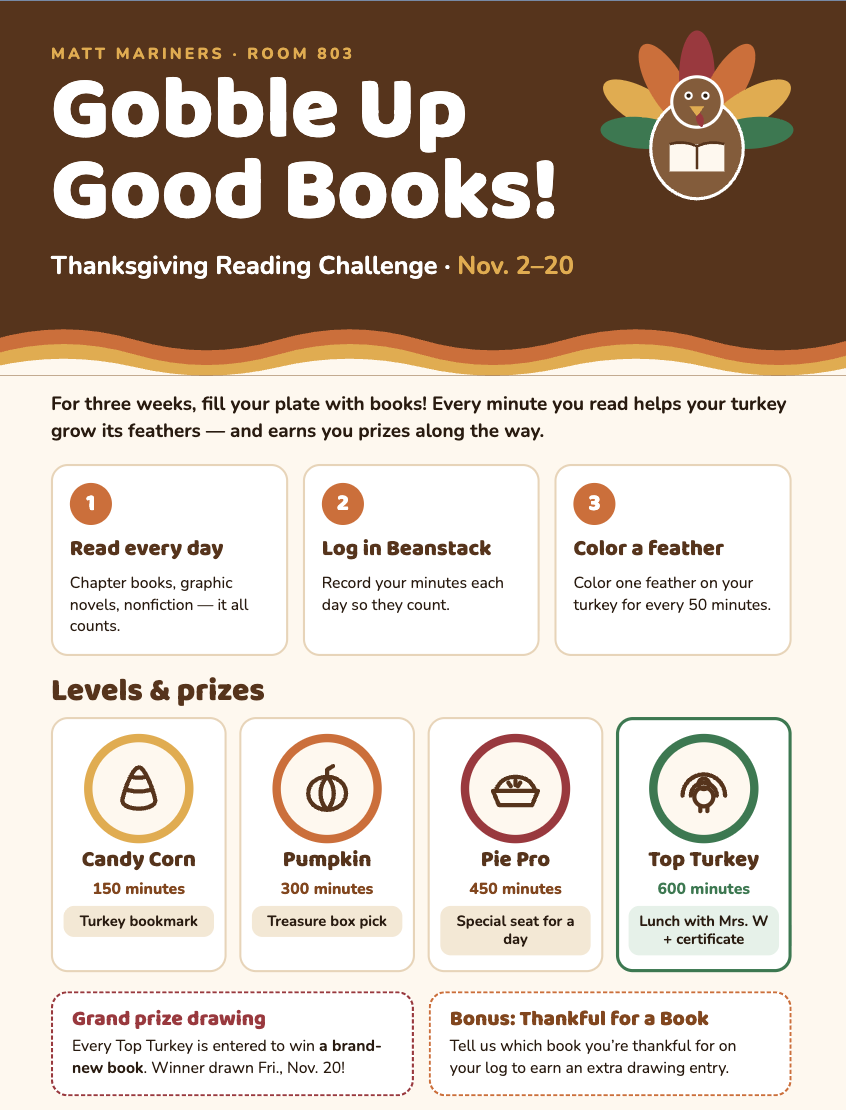
NOVEMBER READING CHALLENGE — GOBBLE UP GOOD BOOKS! · NOVEMBER 2–20
Our Thanksgiving reading challenge continues through Friday, November 20! Keep reading daily and logging minutes in Beanstack to earn feathers and prizes.
- Read every day. Chapter books, graphic novels, and nonfiction all count.
- Log in Beanstack. Record minutes each day so they count.
- Color a feather. Color one feather on the turkey for every 50 minutes read.
Levels & prizes:
- Candy Corn · 150 minutes — Turkey bookmark
- Pumpkin · 300 minutes — Treasure box pick
- Pie Pro · 450 minutes — Special seat for a day
- Top Turkey · 600 minutes — Lunch with Mrs. W + certificate
Grand prize drawing: Every Top Turkey is entered to win a brand-new book. The winner is drawn Friday, November 20! Bonus: write which book you are thankful for on your log to earn an extra drawing entry.
HAPPENING NOW — RESIN DUCK CONTEST BEHAVIOR CHALLENGE
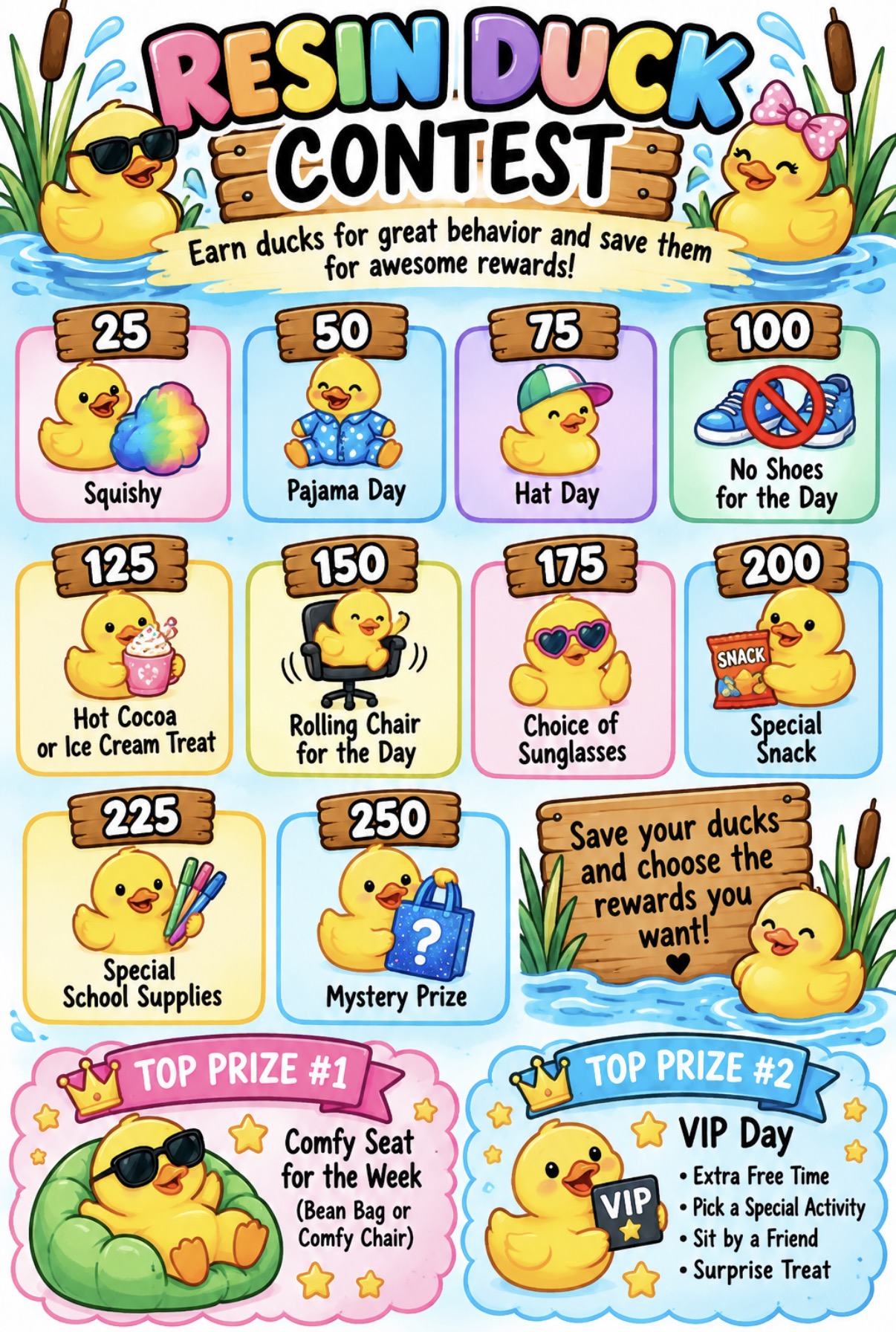
Our Resin Duck Contest behavior challenge is happening now! Students are already earning ducks for their positive choices. Students earn ducks for great behavior, such as being kind, working hard, following directions, and making good choices. Then they save their ducks and choose the rewards they want.
Students can spend ducks right away on a smaller reward or keep saving for something bigger:
- 25 ducks — Squishy
- 50 ducks — Pajama Day
- 75 ducks — Hat Day
- 100 ducks — No Shoes for the Day
- 125 ducks — Hot cocoa or ice cream treat
- 150 ducks — Rolling chair for the day
- 175 ducks — Choice of sunglasses
- 200 ducks — Special snack
- 225 ducks — Special school supplies
- 250 ducks — Mystery prize
Top prizes: Top Prize #1 is a comfy seat for the week (bean bag or comfy chair). Top Prize #2 is a VIP Day with extra free time, a special activity of their choice, sitting by a friend, and a surprise treat. Ask your child how many ducks they have earned and which reward they are saving for!
Specials meet 8:10–8:55 AM. See the November rotation for both classes below.
Hello, Mariner Families! This week we finish our orbit and rotation unit with a test on Monday, take our ELA Unit 3 summative November 10–11, and move into Unit 4 reading and writing. Math continues with division, with a quiz Friday, and science moves into ecosystems. Please practice math facts at home and complete the holiday survey as soon as possible if you have not already. Thank you for your support!
THIS WEEK AT A GLANCE
- Monday, November 9 — Orbit and rotation test
- Tuesday–Wednesday, November 10–11 — ELA Unit 3 summative (review guide in the ELA section below)
- Thursday, November 12 — Begin ELA Unit 4
- Friday, November 13 — Division quiz and Social Studies 17 quiz
- As soon as possible — Complete the holiday survey if you have not already
- Through November 20 — Gobble Up Good Books reading challenge
FAMILY ACTION ITEMS — PLEASE COMPLETE ASAP
Holiday survey: If your family has not filled it out yet, please complete it as soon as possible. We need your response to help us plan!
Charlie Brown Thanksgiving — ELA needs: Please visit the signup to see how you can help with our classroom celebration. Thank you for supporting our students!
STEM FIELD TRIP — MERCEDES-BENZ STADIUM · DECEMBER 9
We are excited to share that our 4th graders are taking a STEM field trip to Mercedes-Benz Stadium on Wednesday, December 9! Students get a behind-the-scenes look at one of Atlanta’s most impressive venues and see how science, math, and design come to life in the real world.
While on the tour, students will:
- Explore how the stadium uses light and sound to communicate with fans, including the massive Halo video board.
- Measure stadium seating and use area, perimeter, and scale to design a model of a seating section.
- Observe how the stadium’s restaurants and spaces are designed, then create their own restaurant concept back in class.
These activities connect directly to our 4th grade science and math standards, and we can’t wait to see what our students design!
CONGRATULATIONS TO OUR SPELLING BEE WINNERS!
Congratulations to our spelling bee winners and runners-up! We are proud of your hard work, preparation, and courage.
Mrs. Wahlstrom’s Class
Winner: Jones
Runner-Up: Eli
Mrs. Henderson’s Class
Winner: Landon
Runner-Up: Jose
Join us in celebrating these students and their achievement!
ELA — UNIT 3 ASSESSMENT & MOVING INTO UNIT 4
Our ELA Unit 3 summative is Tuesday–Wednesday, November 10–11. Use the Unit 3 ELA review guide below to practice every skill on the test. We move into Unit 4 on Thursday, November 12, with a focus on informational reading, vocabulary, word parts, text features, and text evidence.
UNIT 4 READING LEARNING TARGETS
Vocabulary · 4.L.V.1.a
I am learning to figure out the meaning of general, academic, and subject-specific vocabulary by using clues from the text and reading a variety of grade-level materials.
Word Parts · 4.L.V.2.b
I am learning to explain how roots, base words, prefixes, and suffixes are connected to parts of speech so I can figure out what words mean and how they are used in sentences.
Grammar · 4.L.GC.1
I am learning to apply conventions of Standard English grammar, usage, and mechanics to aid the comprehension and analysis of texts and to communicate clearly and precisely in written and spoken language. Our focus: plural possessive nouns and helping verbs.
Text Features & Structures · 4.T.SS.1.a
I am learning to analyze text features and structures used in a variety of texts on the same topic for a specific purpose.
Informational Text · 4.T.T.2.a
I am learning to read informational texts and explain how the author organized their ideas and used facts to teach me about the main topic.
Text Evidence · 4.T.RA.2.a
I am learning to refer to specific passages or quotations from a text to support an idea, answer, or opinion.
WRITING — UNIT 4 · EXPLAINING A TOPIC
We are building informative writing with clear introductions, organized paragraphs, facts, transitions, and strong conclusions. We use evidence from our reading to support our ideas.
Explain a Topic · 4.T.T.2.d
I am learning to write to explain a topic by clearly introducing it, organizing my ideas into paragraphs, using facts and clear language, and ending with a strong conclusion.
Connected Paragraphs · 4.T.SS.1.d
I am learning to write a paragraph with sentences that all go together and use transitions to help my ideas flow smoothly.
Support Ideas · 4.T.RA.2.a
I am learning to refer to specific passages or quotations from a text to support an idea, answer, or opinion.
SOCIAL STUDIES — THE CONSTITUTION · QUIZ SCHEDULE
We are continuing our study of the U.S. Constitution. Students keep learning about the Founders and the process of creating the Constitution: why the Articles of Confederation were too weak, who the major leaders at the Constitutional Convention were, and the debates and compromises that shaped our new government.
Upcoming social studies quizzes:
- Friday, November 13 — Social Studies 17 quiz
- Friday, November 20 — Social Studies 18 quiz
- Tuesday, December 8 — Social Studies Constitution test (the study guide comes home in November)
The study guides for the Social Studies 16, 17, and 18 quizzes are all in one folder below. Use them and the review game to practice at home.
- SS4H3.a–b: The weaknesses of the Articles of Confederation and the major leaders, debates, and compromises of the Constitutional Convention.
- SS4CG1.a–d: Natural rights in the Declaration of Independence, the meaning of “We the People,” the federal system, and the three branches of government.
- SS4CG2: How freedom of expression and First Amendment rights support our representative democracy.
- SS4CG3.a–b: How the three branches work together through checks and balances, and how citizens’ rights and responsibilities help a representative democracy function.
MATH — DIVIDING TENS & ONES BY ONE-DIGIT NUMBERS
This week we keep dividing two-digit numbers by one-digit numbers. Students break a number into tens and ones, divide each part, and then put the parts back together. For example, 84 ÷ 4 = (80 ÷ 4) + (4 ÷ 4) = 20 + 1 = 21.
At home, give your child a two-digit number and a one-digit divisor. Ask them to split the number into tens and ones, divide each part, and check the answer with multiplication.
Tens & Ones
Break a two-digit number into tens and ones to make dividing easier.
Divide Each Part
Divide the tens and the ones by a one-digit number, then add the parts together.
Check with Multiplication
Use multiplication to check that my division answer makes sense.
Division quiz: Friday, November 13. Please practice multiplication and division facts daily to become more fluent with division.
SCIENCE — FINISHING ORBIT & ROTATION · ECOSYSTEMS NEXT
Orbit and rotation test: Monday, November 9. Review how Earth’s rotation causes day and night and how Earth’s orbit around the sun takes one year. After the test, we begin our new Life Science unit: Ecosystems.
S4L1: Obtain, evaluate, and communicate information about the roles of organisms and the flow of energy within an ecosystem.
Organism Roles · S4L1.a
Develop a model to describe the roles of producers, consumers, and decomposers in a community. Students do not need to identify the different types of consumers.
Energy Flow · S4L1.b
Develop simple models to illustrate the flow of energy through a food web or food chain beginning with sunlight and including producers, consumers, and decomposers.
Ecosystem Changes · S4L1.c
Design a scenario to demonstrate the effect of a change on an ecosystem, including living and non-living factors.
Changing Populations · S4L1.d
Use printed and digital data to develop a model illustrating and describing changes to the flow of energy in an ecosystem when plants or animals become scarce, extinct, or overabundant.
FAMILY TALKING POINTS
Reading
How do a heading and a diagram help you understand the same topic? Find a passage that supports your answer.
Writing
Explain something you know well. Can you add facts, a transition, and a strong conclusion?
Math
Solve 84 ÷ 4 by splitting tens and ones. Which multiplication fact checks your answer?
Science
Trace energy from sunlight through a food chain. What might change if plants became scarce?
NOVEMBER READING CHALLENGE — GOBBLE UP GOOD BOOKS! · NOVEMBER 2–20
Our Thanksgiving reading challenge continues through Friday, November 20! Keep reading daily and logging minutes in Beanstack to earn feathers and prizes.
- Read every day. Chapter books, graphic novels, and nonfiction all count.
- Log in Beanstack. Record minutes each day so they count.
- Color a feather. Color one feather on the turkey for every 50 minutes read.
Levels & prizes:
- Candy Corn · 150 minutes — Turkey bookmark
- Pumpkin · 300 minutes — Treasure box pick
- Pie Pro · 450 minutes — Special seat for a day
- Top Turkey · 600 minutes — Lunch with Mrs. W + certificate
Grand prize drawing: Every Top Turkey is entered to win a brand-new book. The winner is drawn Friday, November 20! Bonus: write which book you are thankful for on your log to earn an extra drawing entry.
HAPPENING NOW — RESIN DUCK CONTEST BEHAVIOR CHALLENGE
Our Resin Duck Contest behavior challenge is happening now! Students are already earning ducks for their positive choices. Students earn ducks for great behavior, such as being kind, working hard, following directions, and making good choices. Then they save their ducks and choose the rewards they want.
Students can spend ducks right away on a smaller reward or keep saving for something bigger:
- 25 ducks — Squishy
- 50 ducks — Pajama Day
- 75 ducks — Hat Day
- 100 ducks — No Shoes for the Day
- 125 ducks — Hot cocoa or ice cream treat
- 150 ducks — Rolling chair for the day
- 175 ducks — Choice of sunglasses
- 200 ducks — Special snack
- 225 ducks — Special school supplies
- 250 ducks — Mystery prize
Top prizes: Top Prize #1 is a comfy seat for the week (bean bag or comfy chair). Top Prize #2 is a VIP Day with extra free time, a special activity of their choice, sitting by a friend, and a surprise treat. Ask your child how many ducks they have earned and which reward they are saving for!
Specials meet 8:10–8:55 AM. See the November rotation for both classes below.
Hello, Mariner Families! Welcome to November! We have a Unit 3 vocabulary assessment on Thursday, November 5, then a science unit test and our Social Studies 16 quiz on Friday, November 6. Reading, writing, and social studies continue where we left off, and the Unit 3 summative is coming up next week. In math, we keep dividing tens and ones by one-digit numbers. This week we also kick off the Gobble Up Good Books Thanksgiving reading challenge, and our new Resin Duck Contest behavior challenge is on the way. Thank you for helping your child review at home!
UPCOMING AT A GLANCE
- Monday, November 2 — Gobble Up Good Books reading challenge begins (runs through November 20)
- Thursday, November 5 — ELA Unit 3 vocabulary assessment
- Friday, November 6 — Science unit test
- Friday, November 6 — Social Studies 16 quiz
- Friday, November 6 — Drive-Thru Turkey Drop in the morning car line
- Tuesday–Wednesday, November 10–11 — ELA Unit 3 summative (split over 2 days)
- Thursday, November 12 — ELA Unit 4 begins
- Friday, November 13 — Social Studies 17 quiz
ELA — UNIT 3 · SCRAPS OF TIME
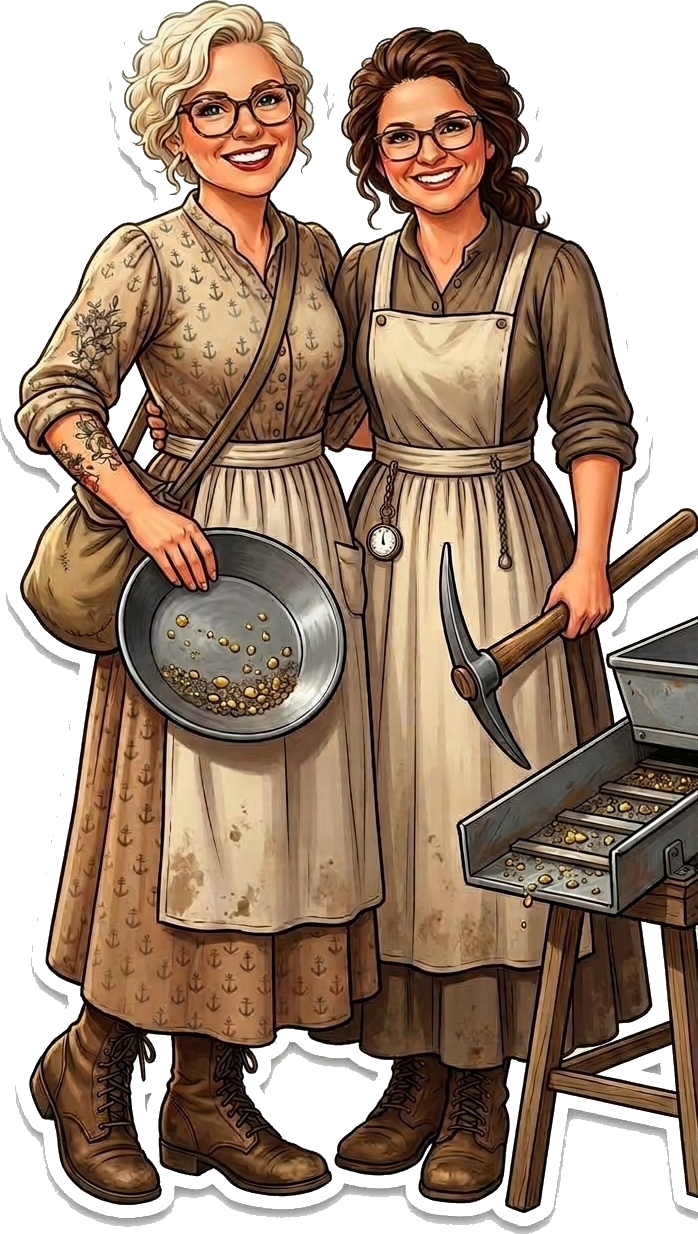
We are continuing ELA Unit 3 with our book, Scraps of Time: Away West, 1879, and readings about the Gold Rush. Students explore historical context, characters, theme, and the ways authors help us understand a story.
Unit 3 vocabulary assessment: Thursday, November 5. The Unit 3 summative follows next week, and it is split over two days so no single day feels too long. Please keep reviewing our reading lessons, vocabulary words, and the learning targets below.
ELA ASSESSMENT CALENDAR
- Thursday, November 5 — Unit 3 vocabulary
- Tuesday–Wednesday, November 10–11 — Unit 3 summative (split over 2 days)
- Thursday, November 12 — Unit 4 begins
- Thursday, November 19 — Unit 4 formative
- Friday, December 4 — Unit 4 vocabulary & morphology
- Tuesday–Thursday, December 8–10 — Unit 4 summative
OUR ELA LEARNING TARGETS
Vocabulary Explorer
I am learning to acquire a range of general, academic, and specialized vocabulary words and phrases through grade-level texts and content (Morpheme Magic and vocabulary).
Word-Part Detective
I can figure out how adding word parts, like prefixes and suffixes, to root words changes what the word means and how it is used in a sentence.
Historical Clues
I am learning to find clues in a story or article that tell me when and where it was written.
Characters, Setting & Plot
I am learning to figure out how authors use storytelling techniques to help me understand the characters, setting, and plot.
Find the Theme
I am learning to find the theme in stories by paying attention to what the characters do, say, and feel.
Grammar in Action
I am learning to apply Standard English grammar, usage, and mechanics to understand texts and communicate clearly in writing and speaking, including proper adjectives and relative pronouns.
Explain What Happened
I am learning to read about history, science, or how things work and explain what happened and why it happened using details from what I read.
Figurative Language
I am learning to find figurative language, such as hyperbole and personification, and explain how it helps me understand the author’s ideas.
Connected Sentences
I am learning to write a paragraph with sentences that all go together.
Explain a Topic
I am learning to explain a topic by clearly introducing it, organizing my ideas into paragraphs, using facts and clear language, and ending with a strong conclusion.
WRITING — UNIT 3 · SETTING OUT WEST
We are continuing Shared Writing Unit 3: Setting Out West, using Scraps of Time and Gold Rush texts as our mentor texts. Students build connected, informative paragraphs with a topic sentence, relevant supporting details, and a strong conclusion.
Morphology review. Before Thursday’s Unit 3 vocabulary assessment, students review the roots, prefixes, and suffixes from this unit, including the root form (“shape”) in words like transform, uniform, and information. Ask your child to break a Unit 3 word into its parts and explain what each part means!
Our writing journey includes planning for Task, Audience, and Purpose (TAP), organizing and outlining paragraphs, choosing evidence, revising sentences, using appositives and subordinating conjunctions, and adding transitions.
Plan with TAP
I am learning to identify the Task, Audience, and Purpose before I start writing.
Build a Paragraph
I am learning to organize a topic sentence, supporting details, and a concluding sentence.
Choose Strong Details
I am learning to use evidence from a text and keep details that support my topic.
Revise & Connect
I am learning to strengthen my sentences and use transitions to help my ideas flow.
Explore our writing learning targets
- I am learning to identify the Task, Audience, and Purpose for a piece of writing.
- I am learning how TAP helps me plan my writing before I start.
- I am learning to identify the topic sentence, supporting details, and concluding sentence in a paragraph.
- I am learning how color-coding helps me see paragraph structure.
- I am learning to tell the difference between a topic sentence and a supporting detail.
- I am learning to put sentences in an order that makes sense.
- I am learning to identify relevant and irrelevant details in a paragraph.
- I am learning to remove details that don't support the topic sentence.
- I am learning to generate supporting details that connect to a topic sentence.
- I am learning to use evidence from a text to build my details.
- I am learning to use different sentence types to write a stronger topic sentence.
- I am learning to use subordinating conjunctions to combine ideas.
- I am learning to revise a topic sentence using sentence types and subordinating conjunctions.
- I am learning to notice sensory details in a mentor text.
- I am learning what an appositive is and how to use one in a sentence.
- I am learning to use appositives to revise my topic sentences.
- I am learning to write a concluding sentence that wraps up my paragraph's main idea.
- I am learning to use all three strategies to strengthen my concluding sentence.
- I am learning to plan a paragraph using a Single Paragraph Outline.
- I am learning to color-code my outline: topic sentence, details, and conclusion.
- I am learning to transcribe my outline into a complete paragraph.
- I am learning to write in complete sentences that flow together.
- I am learning to write a paragraph with sentences that all go together, using transitions to help my ideas flow smoothly.
- I am learning to explain a topic by clearly introducing it, organizing my ideas, using facts and clear language, and ending with a strong conclusion.
- I am learning to use my fine motor skills to form legible letters and words in cursive.
SOCIAL STUDIES — THE CONSTITUTION · QUIZ SCHEDULE
We are continuing our study of the U.S. Constitution. Students keep learning about the Founders and the process of creating the Constitution: why the Articles of Confederation were too weak, who the major leaders at the Constitutional Convention were, and the debates and compromises that shaped our new government.
Upcoming social studies quizzes:
- Friday, November 6 — Social Studies 16 quiz
- Friday, November 13 — Social Studies 17 quiz
- Friday, November 20 — Social Studies 18 quiz
- Tuesday, December 8 — Social Studies Constitution test (the study guide comes home in November)
The study guides for the Social Studies 16, 17, and 18 quizzes are all in one folder below. Use them and the review game to practice at home.
- SS4H3.a–b: The weaknesses of the Articles of Confederation and the major leaders, debates, and compromises of the Constitutional Convention.
- SS4CG1.a–d: Natural rights in the Declaration of Independence, the meaning of “We the People,” the federal system, and the three branches of government.
- SS4CG2: How freedom of expression and First Amendment rights support our representative democracy.
- SS4CG3.a–b: How the three branches work together through checks and balances, and how citizens’ rights and responsibilities help a representative democracy function.
MATH — DIVIDING TENS & ONES BY ONE-DIGIT NUMBERS
This week we keep dividing two-digit numbers by one-digit numbers. Students break a number into tens and ones, divide each part, and then put the parts back together. For example, 84 ÷ 4 = (80 ÷ 4) + (4 ÷ 4) = 20 + 1 = 21.
At home, give your child a two-digit number and a one-digit divisor. Ask them to split the number into tens and ones, divide each part, and check the answer with multiplication.
Tens & Ones
Break a two-digit number into tens and ones to make dividing easier.
Divide Each Part
Divide the tens and the ones by a one-digit number, then add the parts together.
Check with Multiplication
Use multiplication to check that my division answer makes sense.
SCIENCE — ORBIT, ROTATION & THE SOLAR SYSTEM · UNIT TEST 11/6
We are finishing our unit on orbit, rotation, and the solar system. Students explain how Earth’s rotation on its axis causes day and night, how Earth’s orbit around the sun makes a year, and how the planets in our solar system move around the sun.
Science unit test: Friday, November 6. Please help your child review rotation, orbit, and the solar system this week.
Rotation: Day & Night
Explain how Earth spinning on its axis causes day and night.
Orbit: One Year
Explain how Earth travels around the sun in an orbit that takes one year.
Solar System Explorer
Describe the planets and how they orbit the sun in our solar system.
FAMILY TALKING POINTS — ASK ME SOMETHING FUN!
Skip “What did you do at school today?” and pick a question below. Each one connects to this week’s learning!
ELA · Scraps of Time Check-In
What is happening in Scraps of Time right now? What clue from the story tells you when and where it takes place?
ELA · Vocab Warm-Up
Pick a vocabulary word from Unit 3. What does it mean, and can you use it in a sentence?
Writing · Word-Part Builder
Pick a Unit 3 word with a prefix or suffix. What is the root, and how does each word part change the meaning?
Writing · Build It Together
Say a topic sentence about something you know well. Can everyone add a related detail, then finish with a strong concluding sentence?
Math · Split It Up
How can you solve 84 ÷ 4 by splitting 84 into 80 and 4? What do you get for each part?
Math · Fair Shares
If 3 friends share 69 stickers equally, how many does each friend get? How can multiplication check your answer?
Science · Spin & Shine
Use a flashlight and a ball to show why it is day on one side of Earth and night on the other.
Science · Rotation or Orbit?
What is the difference between rotation and orbit? Which one takes a day, and which one takes a year?
Make it a game: let your child pick a box, teach you something, and then ask the grown-ups a question too!
NOVEMBER READING CHALLENGE — GOBBLE UP GOOD BOOKS! · NOVEMBER 2–20
Our Thanksgiving reading challenge starts Monday! For three weeks, students fill their plates with books. Every minute they read helps their turkey grow its feathers and earns prizes along the way.
- Read every day. Chapter books, graphic novels, and nonfiction all count.
- Log in Beanstack. Record minutes each day so they count.
- Color a feather. Color one feather on the turkey for every 50 minutes read.
Levels & prizes:
- Candy Corn · 150 minutes — Turkey bookmark
- Pumpkin · 300 minutes — Treasure box pick
- Pie Pro · 450 minutes — Special seat for a day
- Top Turkey · 600 minutes — Lunch with Mrs. W + certificate
Grand prize drawing: Every Top Turkey is entered to win a brand-new book. The winner is drawn Friday, November 20! Bonus: write which book you are thankful for on your log to earn an extra drawing entry.
COMING SOON — RESIN DUCK CONTEST BEHAVIOR CHALLENGE
Get ready to make some waves! Our new behavior challenge, the Resin Duck Contest, is coming soon. Students earn ducks for great behavior, such as being kind, working hard, following directions, and making good choices. Then they save their ducks and choose the rewards they want.
Students can spend ducks right away on a smaller reward or keep saving for something bigger:
- 25 ducks — Squishy
- 50 ducks — Pajama Day
- 75 ducks — Hat Day
- 100 ducks — No Shoes for the Day
- 125 ducks — Hot cocoa or ice cream treat
- 150 ducks — Rolling chair for the day
- 175 ducks — Choice of sunglasses
- 200 ducks — Special snack
- 225 ducks — Special school supplies
- 250 ducks — Mystery prize
Top prizes: Top Prize #1 is a comfy seat for the week (bean bag or comfy chair). Top Prize #2 is a VIP Day with extra free time, a special activity of their choice, sitting by a friend, and a surprise treat. Ask your child how many ducks they have earned and which reward they are saving for!
- MON NOV 2 — Gobble Up Good Books reading challenge begins
- THU NOV 5 — ELA Unit 3 vocabulary assessment
- FRI NOV 6 — Science unit test · Social Studies 16 quiz · Drive-Thru Turkey Drop in the morning car line
- TUE–WED NOV 10–11 — ELA Unit 3 summative (split over 2 days)
- THU NOV 12 — ELA Unit 4 begins
- FRI NOV 13 — Social Studies 17 quiz
- THU NOV 19 — ELA Unit 4 formative
- FRI NOV 20 — Social Studies 18 quiz · Gobble Up Good Books ends and grand prize drawing
- MON–FRI NOV 23–27 — Thanksgiving Break · no school
- MON NOV 30 — School resumes
- FRI DEC 4 — ELA Unit 4 vocabulary & morphology
- TUE DEC 8 — Social Studies Constitution test
- TUE–THU DEC 8–10 — ELA Unit 4 summative
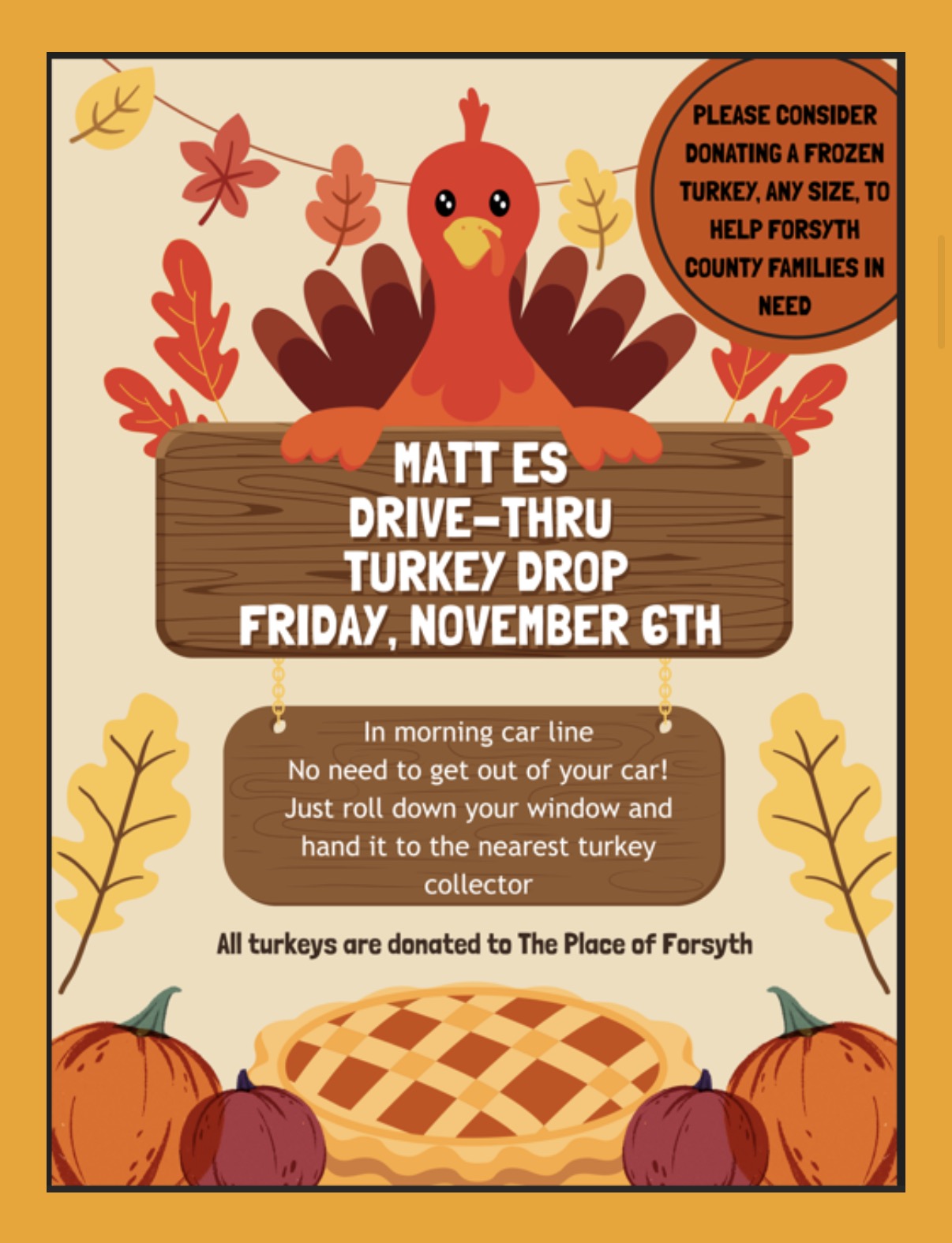
Drive-Thru Turkey Drop: Please consider donating a frozen turkey, any size, to help Forsyth County families in need. On Friday, November 6, just roll down your window in the morning car line and hand it to the nearest turkey collector. All turkeys go to The Place of Forsyth.
Specials meet 8:10 – 8:55 AM every day on the 8-day color rotation. This week starts on Day 7 Violet, Monday, November 2. There is no school November 23 – 27 for Thanksgiving Break. The rotation pauses over the break, so school and specials pick back up with Day 6 Indigo on Monday, November 30.
Hello, Mariner Families! This is a busy week. We have a math quiz on Monday, October 26, our first Constitution quiz on Wednesday and our first Unit 3 reading formative on Thursday. Reading and writing continue in Unit 3, and this week’s morphology focus is the root form. In math, we start dividing tens and ones by one-digit numbers. In science, we finish our unit on orbit, rotation, and the solar system. Thank you for helping your child review at home!
UPCOMING AT A GLANCE
- Monday, October 26 — Math quiz
- Monday–Friday, October 26–30 — Red Ribbon Week spirit days (see below)
- Tuesday, October 27 — North United Trunk or Treat · 5:30–7:00 PM
- Wednesday, October 28 — Constitution Quiz 1: The Founders & the Process
- Thursday, October 29 — First Unit 3 reading formative
- Sunday, November 1 — Matt Glow Run
- Friday, November 6 — Drive-Thru Turkey Drop in the morning car line
ELA — UNIT 3 · SCRAPS OF TIME
We are continuing ELA Unit 3 with our book, Scraps of Time: Away West, 1879, and readings about the Gold Rush. Students explore historical context, characters, theme, and the ways authors help us understand a story.
First Unit 3 reading formative: Thursday, October 29. Please help your child review our reading lessons, vocabulary words, and the learning targets below this week.
OUR ELA LEARNING TARGETS
Vocabulary Explorer
I am learning to acquire a range of general, academic, and specialized vocabulary words and phrases through grade-level texts and content (Morpheme Magic and vocabulary).
Word-Part Detective
I can figure out how adding word parts, like prefixes and suffixes, to root words changes what the word means and how it is used in a sentence.
Historical Clues
I am learning to find clues in a story or article that tell me when and where it was written.
Characters, Setting & Plot
I am learning to figure out how authors use storytelling techniques to help me understand the characters, setting, and plot.
Find the Theme
I am learning to find the theme in stories by paying attention to what the characters do, say, and feel.
Grammar in Action
I am learning to apply Standard English grammar, usage, and mechanics to understand texts and communicate clearly in writing and speaking, including proper adjectives and relative pronouns.
Explain What Happened
I am learning to read about history, science, or how things work and explain what happened and why it happened using details from what I read.
Figurative Language
I am learning to find figurative language, such as hyperbole and personification, and explain how it helps me understand the author’s ideas.
Connected Sentences
I am learning to write a paragraph with sentences that all go together.
Explain a Topic
I am learning to explain a topic by clearly introducing it, organizing my ideas into paragraphs, using facts and clear language, and ending with a strong conclusion.
WRITING — UNIT 3 · SETTING OUT WEST
We are continuing Shared Writing Unit 3: Setting Out West, using Scraps of Time and Gold Rush texts as our mentor texts. Students build connected, informative paragraphs with a topic sentence, relevant supporting details, and a strong conclusion.
Morphology focus: the root form. The root form means “shape.” Students look at how prefixes and suffixes build new words from this root, such as transform (change shape), reform (shape again), uniform (one shape), formation, and information. Ask your child how many form words they can find at home!
Our writing journey includes planning for Task, Audience, and Purpose (TAP), organizing and outlining paragraphs, choosing evidence, revising sentences, using appositives and subordinating conjunctions, and adding transitions.
Plan with TAP
I am learning to identify the Task, Audience, and Purpose before I start writing.
Build a Paragraph
I am learning to organize a topic sentence, supporting details, and a concluding sentence.
Choose Strong Details
I am learning to use evidence from a text and keep details that support my topic.
Revise & Connect
I am learning to strengthen my sentences and use transitions to help my ideas flow.
Explore our writing learning targets
- I am learning to identify the Task, Audience, and Purpose for a piece of writing.
- I am learning how TAP helps me plan my writing before I start.
- I am learning to identify the topic sentence, supporting details, and concluding sentence in a paragraph.
- I am learning how color-coding helps me see paragraph structure.
- I am learning to tell the difference between a topic sentence and a supporting detail.
- I am learning to put sentences in an order that makes sense.
- I am learning to identify relevant and irrelevant details in a paragraph.
- I am learning to remove details that don't support the topic sentence.
- I am learning to generate supporting details that connect to a topic sentence.
- I am learning to use evidence from a text to build my details.
- I am learning to use different sentence types to write a stronger topic sentence.
- I am learning to use subordinating conjunctions to combine ideas.
- I am learning to revise a topic sentence using sentence types and subordinating conjunctions.
- I am learning to notice sensory details in a mentor text.
- I am learning what an appositive is and how to use one in a sentence.
- I am learning to use appositives to revise my topic sentences.
- I am learning to write a concluding sentence that wraps up my paragraph's main idea.
- I am learning to use all three strategies to strengthen my concluding sentence.
- I am learning to plan a paragraph using a Single Paragraph Outline.
- I am learning to color-code my outline: topic sentence, details, and conclusion.
- I am learning to transcribe my outline into a complete paragraph.
- I am learning to write in complete sentences that flow together.
- I am learning to write a paragraph with sentences that all go together, using transitions to help my ideas flow smoothly.
- I am learning to explain a topic by clearly introducing it, organizing my ideas, using facts and clear language, and ending with a strong conclusion.
- I am learning to use my fine motor skills to form legible letters and words in cursive.
SOCIAL STUDIES — CONSTITUTION QUIZ 1 · THE FOUNDERS & THE PROCESS
We are continuing our study of the U.S. Constitution. Our first quiz covers the Founders and the process of creating the Constitution: why the Articles of Confederation were too weak, who the major leaders at the Constitutional Convention were, and the debates and compromises that shaped our new government.
Constitution Quiz 1: Wednesday, October 28. Use the review game below to practice at home.
- SS4H3.a–b: The weaknesses of the Articles of Confederation and the major leaders, debates, and compromises of the Constitutional Convention.
- SS4CG1.a–d: Natural rights in the Declaration of Independence, the meaning of “We the People,” the federal system, and the three branches of government.
- SS4CG2: How freedom of expression and First Amendment rights support our representative democracy.
- SS4CG3.a–b: How the three branches work together through checks and balances, and how citizens’ rights and responsibilities help a representative democracy function.
MATH — DIVIDING TENS & ONES BY ONE-DIGIT NUMBERS
Math quiz: Monday, October 26 (10/26).
This week we start dividing two-digit numbers by one-digit numbers. Students break a number into tens and ones, divide each part, and then put the parts back together. For example, 84 ÷ 4 = (80 ÷ 4) + (4 ÷ 4) = 20 + 1 = 21.
At home, give your child a two-digit number and a one-digit divisor. Ask them to split the number into tens and ones, divide each part, and check the answer with multiplication.
Tens & Ones
Break a two-digit number into tens and ones to make dividing easier.
Divide Each Part
Divide the tens and the ones by a one-digit number, then add the parts together.
Check with Multiplication
Use multiplication to check that my division answer makes sense.
SCIENCE — FINISHING ORBIT, ROTATION & THE SOLAR SYSTEM
We are finishing our unit on orbit, rotation, and the solar system. Students explain how Earth’s rotation on its axis causes day and night, how Earth’s orbit around the sun makes a year, and how the planets in our solar system move around the sun.
Rotation: Day & Night
Explain how Earth spinning on its axis causes day and night.
Orbit: One Year
Explain how Earth travels around the sun in an orbit that takes one year.
Solar System Explorer
Describe the planets and how they orbit the sun in our solar system.
FAMILY TALKING POINTS — ASK ME SOMETHING FUN!
Skip “What did you do at school today?” and pick a question below. Each one connects to this week’s learning!
ELA · Scraps of Time Check-In
What is happening in Scraps of Time right now? What clue from the story tells you when and where it takes place?
ELA · Formative Warm-Up
Pick a vocabulary word from Unit 3. What does it mean, and can you use it in a sentence?
Writing · Form Word Hunt
The root form means “shape.” What do transform, uniform, and reform mean? Can you think of another form word?
Writing · Build It Together
Say a topic sentence about something you know well. Can everyone add a related detail, then finish with a strong concluding sentence?
Math · Split It Up
How can you solve 84 ÷ 4 by splitting 84 into 80 and 4? What do you get for each part?
Math · Fair Shares
If 3 friends share 69 stickers equally, how many does each friend get? How can multiplication check your answer?
Science · Spin & Shine
Use a flashlight and a ball to show why it is day on one side of Earth and night on the other.
Science · Rotation or Orbit?
What is the difference between rotation and orbit? Which one takes a day, and which one takes a year?
Make it a game: let your child pick a box, teach you something, and then ask the grown-ups a question too!
FALL PROJECT — PUMPKIN BOOK CHARACTERS
We are so excited to share a fun fall project! This month, students are completing a Pumpkin Book Character Project at home. Each student chooses a book they have read and decorates a pumpkin to look like a character from that book. Students also complete the linked slides to share information about their book and character.
- Pumpkins may be real or artificial. Please do not carve them; they will be on display in our classroom.
- Use paint, markers, felt, yarn, construction paper, or anything already at home. Creativity is encouraged, and nothing needs to be purchased!
- Students should do as much of the work as possible on their own. Family help is welcome, but we want this project to show off their ideas.
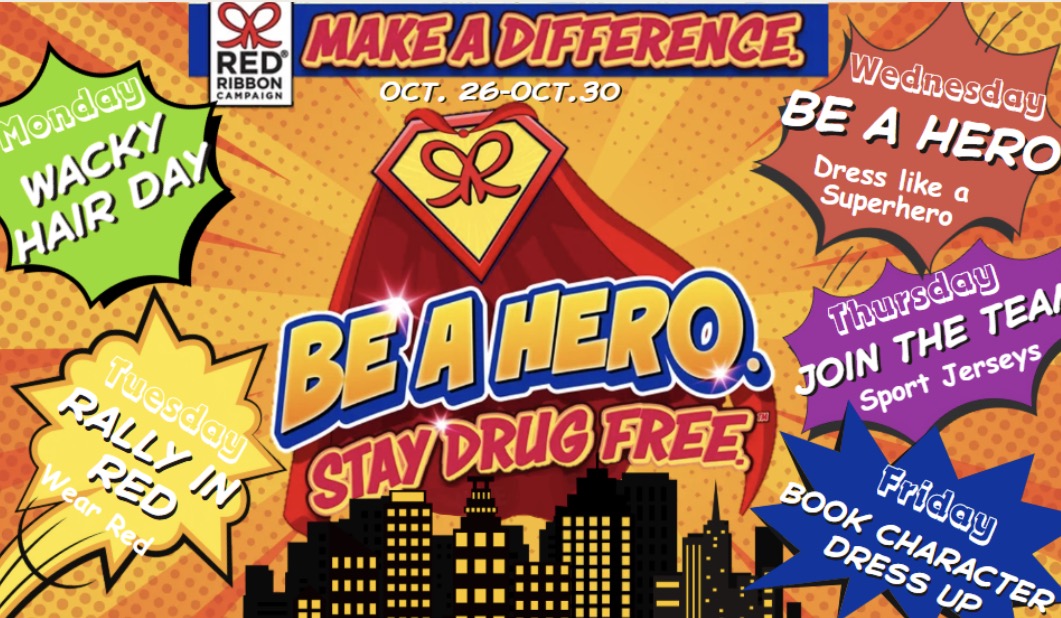
RED RIBBON WEEK — BE A HERO, STAY DRUG FREE · OCTOBER 26–30
Red Ribbon Week is all week long! Join in each day's dress-up theme:
- Monday, October 26 — Wacky Hair Day
- Tuesday, October 27 — Rally in Red: wear red
- Wednesday, October 28 — Be a Hero: dress like a superhero
- Thursday, October 29 — Join the Team: wear a sports jersey
- Friday, October 30 — Book Character Dress-Up
- TUE OCT 27 — North United Trunk or Treat · 5:30–7:00 PM at North Forsyth High School
- WED OCT 28 — Constitution Quiz 1: The Founders & the Process
- THU OCT 29 — First Unit 3 reading formative
- SUN NOV 1 — Matt Glow Run · 5K at 5:00 PM and Fun Run at 5:45 PM
- FRI NOV 6 — Matt ES Drive-Thru Turkey Drop · morning car line
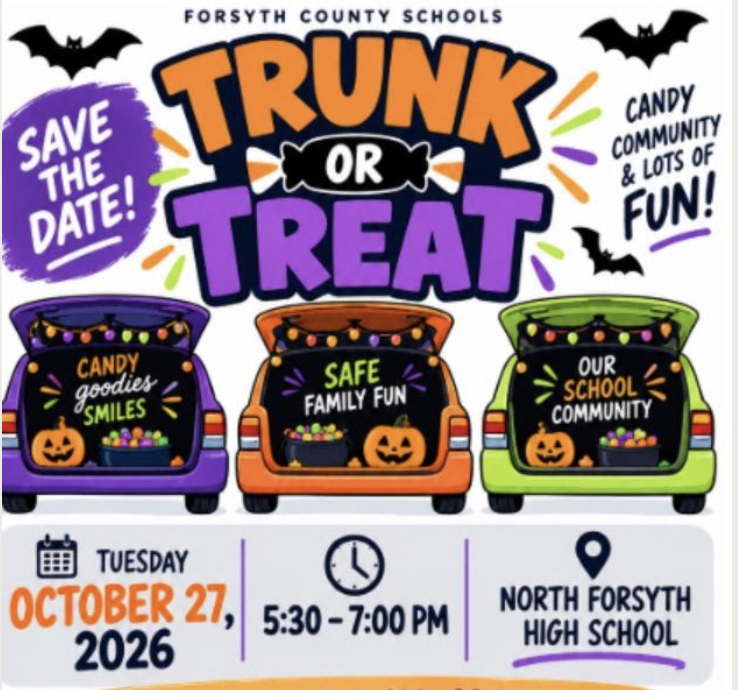
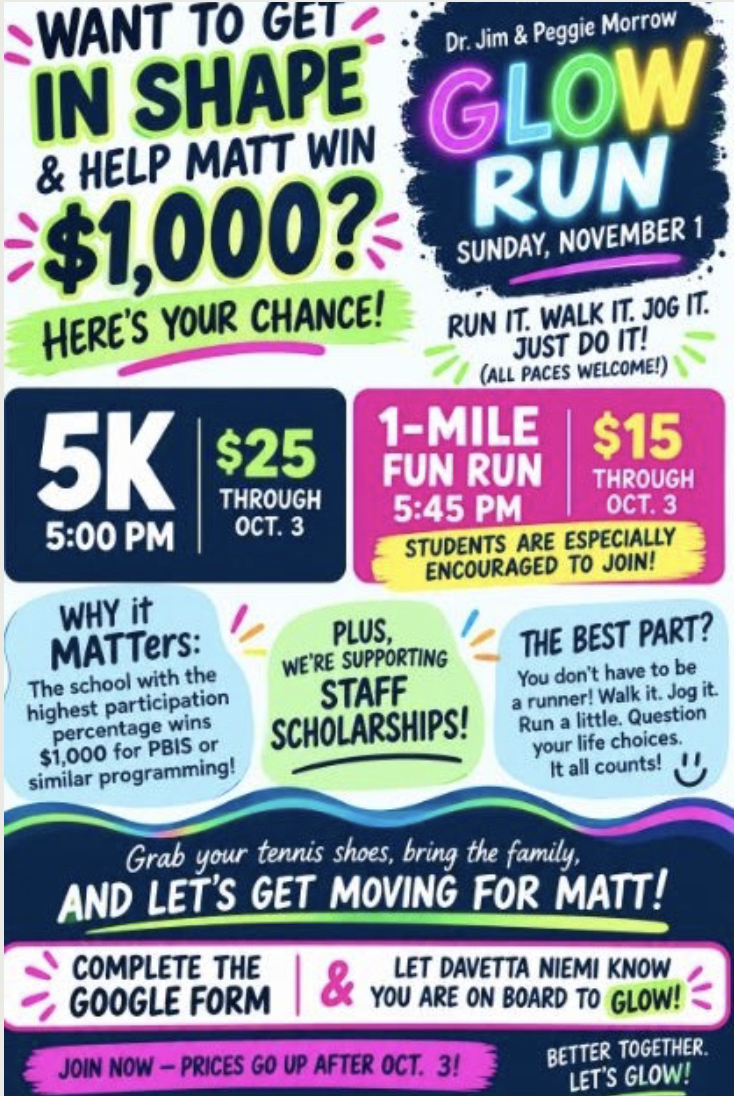
Drive-Thru Turkey Drop: Please consider donating a frozen turkey, any size, to help Forsyth County families in need. On Friday, November 6, just roll down your window in the morning car line and hand it to the nearest turkey collector. All turkeys go to The Place of Forsyth.
Hello, Mariner Families! It was great meeting with all of you for conferences! Thank you for taking the time to talk about your child’s progress and for partnering with us. This week, reading and writing continue in Unit 3, social studies moves into the Constitution, math continues Module 2 multiplication, and science continues our exploration of space and the solar system.
UPCOMING AT A GLANCE
- Wednesday, October 21 — Picture retakes
- Friday, October 23 — 50th day of school celebration
- Wednesday, October 28 — First Constitution quiz
- Thursday, October 29 — First Unit 3 reading formative
ELA — UNIT 3 · SCRAPS OF TIME
We are starting ELA Unit 3 with a new book, Scraps of Time: Away West, 1879, and readings about the Gold Rush. Students explore historical context, characters, theme, and the ways authors help us understand a story.
First Unit 3 reading formative: Thursday, October 29. Review our reading lessons, vocabulary, and learning targets.
OUR ELA LEARNING TARGETS
Vocabulary Explorer
I am learning to acquire a range of general, academic, and specialized vocabulary words and phrases through grade-level texts and content (Morpheme Magic and vocabulary).
Word-Part Detective
I can figure out how adding word parts, like prefixes and suffixes, to root words changes what the word means and how it is used in a sentence.
Historical Clues
I am learning to find clues in a story or article that tell me when and where it was written.
Characters, Setting & Plot
I am learning to figure out how authors use storytelling techniques to help me understand the characters, setting, and plot.
Find the Theme
I am learning to find the theme in stories by paying attention to what the characters do, say, and feel.
Grammar in Action
I am learning to apply Standard English grammar, usage, and mechanics to understand texts and communicate clearly in writing and speaking, including proper adjectives and relative pronouns.
Explain What Happened
I am learning to read about history, science, or how things work and explain what happened and why it happened using details from what I read.
Figurative Language
I am learning to find figurative language, such as hyperbole and personification, and explain how it helps me understand the author’s ideas.
Connected Sentences
I am learning to write a paragraph with sentences that all go together.
Explain a Topic
I am learning to explain a topic by clearly introducing it, organizing my ideas into paragraphs, using facts and clear language, and ending with a strong conclusion.
WRITING — UNIT 3 · SETTING OUT WEST
We are beginning Shared Writing Unit 3: Setting Out West, using Scraps of Time and Gold Rush texts as our mentor texts. Students build connected, informative paragraphs with a topic sentence, relevant supporting details, and a strong conclusion.
Our writing journey includes planning for Task, Audience, and Purpose (TAP), organizing and outlining paragraphs, choosing evidence, revising sentences, using appositives and subordinating conjunctions, and adding transitions.
Plan with TAP
I am learning to identify the Task, Audience, and Purpose before I start writing.
Build a Paragraph
I am learning to organize a topic sentence, supporting details, and a concluding sentence.
Choose Strong Details
I am learning to use evidence from a text and keep details that support my topic.
Revise & Connect
I am learning to strengthen my sentences and use transitions to help my ideas flow.
Explore our writing learning targets
- I am learning to identify the Task, Audience, and Purpose for a piece of writing.
- I am learning how TAP helps me plan my writing before I start.
- I am learning to identify the topic sentence, supporting details, and concluding sentence in a paragraph.
- I am learning how color-coding helps me see paragraph structure.
- I am learning to tell the difference between a topic sentence and a supporting detail.
- I am learning to put sentences in an order that makes sense.
- I am learning to identify relevant and irrelevant details in a paragraph.
- I am learning to remove details that don't support the topic sentence.
- I am learning to generate supporting details that connect to a topic sentence.
- I am learning to use evidence from a text to build my details.
- I am learning to use different sentence types to write a stronger topic sentence.
- I am learning to use subordinating conjunctions to combine ideas.
- I am learning to revise a topic sentence using sentence types and subordinating conjunctions.
- I am learning to notice sensory details in a mentor text.
- I am learning what an appositive is and how to use one in a sentence.
- I am learning to use appositives to revise my topic sentences.
- I am learning to write a concluding sentence that wraps up my paragraph's main idea.
- I am learning to use all three strategies to strengthen my concluding sentence.
- I am learning to plan a paragraph using a Single Paragraph Outline.
- I am learning to color-code my outline: topic sentence, details, and conclusion.
- I am learning to transcribe my outline into a complete paragraph.
- I am learning to write in complete sentences that flow together.
- I am learning to write a paragraph with sentences that all go together, using transitions to help my ideas flow smoothly.
- I am learning to explain a topic by clearly introducing it, organizing my ideas, using facts and clear language, and ending with a strong conclusion.
- I am learning to use my fine motor skills to form legible letters and words in cursive.
SOCIAL STUDIES — THE CONSTITUTION
We are moving into the U.S. Constitution and our new nation’s government. Students explore why the Articles of Confederation needed to be replaced, how the Constitutional Convention created a stronger government, and how “We the People” connects to self-government. We also learn about the three branches, checks and balances, freedom of expression, the First Amendment, and the rights and responsibilities of citizens.
- SS4H3.a–b: The weaknesses of the Articles of Confederation and the major leaders, debates, and compromises of the Constitutional Convention.
- SS4CG1.a–d: Natural rights in the Declaration of Independence, the meaning of “We the People,” the federal system, and the three branches of government.
- SS4CG2: How freedom of expression and First Amendment rights support our representative democracy.
- SS4CG3.a–b: How the three branches work together through checks and balances, and how citizens’ rights and responsibilities help a representative democracy function.
First Constitution quiz: Wednesday, October 28.
MATH — MODULE 2 · MULTIPLICATION STRATEGIES
We are continuing Module 2, multiplying with the distributive property and area models. Students break numbers into parts, find partial products, and add them to find the total. For example, 6 × 14 = (6 × 10) + (6 × 4) = 84.
At home, ask your child to solve a multiplication problem using both strategies and explain how the answers match.
Break It Apart
Use the distributive property to break a multiplication problem into smaller parts.
Draw an Area Model
Use an area model to show partial products and find their sum.
Explain & Check
Explain my multiplication strategy and check my work.
SCIENCE — THE MOON & SOLAR SYSTEM
We are continuing our study of space and the solar system, including the planets, the moon’s phases, and the relationship between the sun, Earth, and moon. Students use observations and models to explain patterns in space.
Moon Phase Detective
Use observations to explain the repeating pattern of the moon’s phases.
Sun, Earth & Moon
Model the relationship between the sun, Earth, and moon.
Solar System Explorer
Explore the planets and how a model represents the solar system.
FAMILY TALKING POINTS — ASK ME SOMETHING FUN!
Skip “What did you do at school today?” and pick a question below. Each one connects to this week’s learning!
ELA · Character Detective
What has a character done, said, or felt in Scraps of Time? What does that clue tell you about the character?
ELA · Word-Part Challenge
Choose a root word and add a prefix or suffix. How does its meaning change? Use your new word in a sentence.
Writing · Who Am I Writing For?
If you explain the Gold Rush to a younger student, who is your audience and what is your purpose? How does that change your writing?
Writing · Build It Together
Say a topic sentence about something you know well. Can everyone add a related detail, then finish with a strong concluding sentence?
Math · Break It Apart
How can you solve 6 × 14 by breaking 14 into 10 + 4? Explain how the two smaller products fit together.
Math · Strategy Showdown
Solve the same multiplication problem with the distributive property and the area model. How can you check that both answers match?
Science · Moon Watch
Look at the moon or draw the phase you last observed. What do you notice, and what pattern are you learning about?
Science · Space Tour Guide
Choose a planet you are learning about. What would you show a visitor, and how could a model help you explain its place in the solar system?
Make it a game: let your child pick a box, teach you something, and then ask the grown-ups a question too!
FALL PROJECT — PUMPKIN BOOK CHARACTERS
We are so excited to share a fun fall project! This month, students are completing a Pumpkin Book Character Project at home. Each student chooses a book they have read and decorates a pumpkin to look like a character from that book. Students also complete the linked slides to share information about their book and character.
- Pumpkins may be real or artificial. Please do not carve them; they will be on display in our classroom.
- Use paint, markers, felt, yarn, construction paper, or anything already at home. Creativity is encouraged, and nothing needs to be purchased!
- Students should do as much of the work as possible on their own. Family help is welcome, but we want this project to show off their ideas.
- WED OCT 21 — Picture retakes
- FRI OCT 23 — 50th day of school celebration
- WED OCT 28 — First Constitution quiz
- THU OCT 29 — First Unit 3 reading formative
- TUE OCT 27 — North United Trunk or Treat · 5:30–7:00 PM at North Forsyth High School
- SUN NOV 1 — Matt Glow Run · 5K at 5:00 PM and Fun Run at 5:45 PM
Tuesday, October 20 is Indigo Day: Mrs. Wahlstrom’s class has Media Center, and Mrs. Henderson’s class has Health & Wellness.
Hello, Mariner Families! This week brings a new reading adventure, a new writing unit, and a Revolutionary War battle poster. We are also sharing our at-home Pumpkin Book Character Project. Please note Monday’s vocabulary quiz, Thursday’s math quiz, and Friday’s online learning day.
THIS WEEK AT A GLANCE
- Monday, October 12 — Unit 2 vocabulary and morphology quiz
- Thursday, October 15 — Math quiz
- Friday, October 16 — Online learning day
ELA — UNIT 3 · SCRAPS OF TIME
We are starting ELA Unit 3 with a new book, Scraps of Time: Away West, 1879, and readings about the Gold Rush. Students explore historical context, characters, theme, and the ways authors help us understand a story.
Unit 2 vocabulary and morphology quiz: Monday, October 12. Use the study guide to review. Our Unit 3 formative assessment is Tuesday, October 27.
OUR ELA LEARNING TARGETS
Vocabulary Explorer
I am learning to acquire a range of general, academic, and specialized vocabulary words and phrases through grade-level texts and content (Morpheme Magic and vocabulary).
Word-Part Detective
I can figure out how adding word parts, like prefixes and suffixes, to root words changes what the word means and how it is used in a sentence.
Historical Clues
I am learning to find clues in a story or article that tell me when and where it was written.
Characters, Setting & Plot
I am learning to figure out how authors use storytelling techniques to help me understand the characters, setting, and plot.
Find the Theme
I am learning to find the theme in stories by paying attention to what the characters do, say, and feel.
Grammar in Action
I am learning to apply Standard English grammar, usage, and mechanics to understand texts and communicate clearly in writing and speaking, including proper adjectives and relative pronouns.
Explain What Happened
I am learning to read about history, science, or how things work and explain what happened and why it happened using details from what I read.
Figurative Language
I am learning to find figurative language, such as hyperbole and personification, and explain how it helps me understand the author’s ideas.
Connected Sentences
I am learning to write a paragraph with sentences that all go together.
Explain a Topic
I am learning to explain a topic by clearly introducing it, organizing my ideas into paragraphs, using facts and clear language, and ending with a strong conclusion.
WRITING — UNIT 3 · SETTING OUT WEST
We are beginning Shared Writing Unit 3: Setting Out West, using Scraps of Time and Gold Rush texts as our mentor texts. Students build connected, informative paragraphs with a topic sentence, relevant supporting details, and a strong conclusion.
Our writing journey includes planning for Task, Audience, and Purpose (TAP), organizing and outlining paragraphs, choosing evidence, revising sentences, using appositives and subordinating conjunctions, and adding transitions.
Plan with TAP
I am learning to identify the Task, Audience, and Purpose before I start writing.
Build a Paragraph
I am learning to organize a topic sentence, supporting details, and a concluding sentence.
Choose Strong Details
I am learning to use evidence from a text and keep details that support my topic.
Revise & Connect
I am learning to strengthen my sentences and use transitions to help my ideas flow.
Explore our writing learning targets
- I am learning to identify the Task, Audience, and Purpose for a piece of writing.
- I am learning how TAP helps me plan my writing before I start.
- I am learning to identify the topic sentence, supporting details, and concluding sentence in a paragraph.
- I am learning how color-coding helps me see paragraph structure.
- I am learning to tell the difference between a topic sentence and a supporting detail.
- I am learning to put sentences in an order that makes sense.
- I am learning to identify relevant and irrelevant details in a paragraph.
- I am learning to remove details that don't support the topic sentence.
- I am learning to generate supporting details that connect to a topic sentence.
- I am learning to use evidence from a text to build my details.
- I am learning to use different sentence types to write a stronger topic sentence.
- I am learning to use subordinating conjunctions to combine ideas.
- I am learning to revise a topic sentence using sentence types and subordinating conjunctions.
- I am learning to notice sensory details in a mentor text.
- I am learning what an appositive is and how to use one in a sentence.
- I am learning to use appositives to revise my topic sentences.
- I am learning to write a concluding sentence that wraps up my paragraph's main idea.
- I am learning to use all three strategies to strengthen my concluding sentence.
- I am learning to plan a paragraph using a Single Paragraph Outline.
- I am learning to color-code my outline: topic sentence, details, and conclusion.
- I am learning to transcribe my outline into a complete paragraph.
- I am learning to write in complete sentences that flow together.
- I am learning to write a paragraph with sentences that all go together, using transitions to help my ideas flow smoothly.
- I am learning to explain a topic by clearly introducing it, organizing my ideas, using facts and clear language, and ending with a strong conclusion.
- I am learning to use my fine motor skills to form legible letters and words in cursive.
SOCIAL STUDIES — REVOLUTIONARY WAR BATTLE POSTER
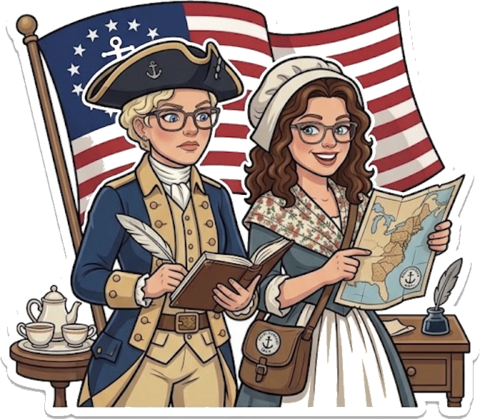
Our historians are creating a Revolutionary War Battle Poster Project this week. Each student chooses a battle and researches these questions for their poster:
MATH — MULTIPLICATION STRATEGIES
We are continuing to multiply using the distributive property and the standard algorithm. Students practice both strategies and explain how they find their products.
Math quiz: Thursday, October 15. At home, ask your child to solve a multiplication problem using both strategies and explain how the answers match.
Break It Apart
Use the distributive property to break a multiplication problem into smaller parts.
Multiply Step by Step
Use the standard algorithm to multiply accurately.
Explain & Check
Explain my multiplication strategy and check my work.
SCIENCE — THE MOON & SOLAR SYSTEM
We are continuing to learn about the moon and beginning to explore the solar system. Watch for a letter with details about our upcoming Solar System Project.
Moon Phase Detective
Use observations to explain the repeating pattern of the moon’s phases.
Sun, Earth & Moon
Model the relationship between the sun, Earth, and moon.
Solar System Explorer
Explore the planets and how a model represents the solar system.
FAMILY TALKING POINTS — ASK ME SOMETHING FUN!
Skip “What did you do at school today?” and pick a question below. Each one connects to this week’s learning!
ELA · Character Detective
What has a character done, said, or felt in Scraps of Time? What does that clue tell you about the character?
ELA · Word-Part Challenge
Choose a root word and add a prefix or suffix. How does its meaning change? Use your new word in a sentence.
Writing · Who Am I Writing For?
If you explain the Gold Rush to a younger student, who is your audience and what is your purpose? How does that change your writing?
Writing · Build It Together
Say a topic sentence about something you know well. Can everyone add a related detail, then finish with a strong concluding sentence?
Math · Break It Apart
How can you solve 6 × 14 by breaking 14 into 10 + 4? Explain how the two smaller products fit together.
Math · Strategy Showdown
Solve the same multiplication problem with the distributive property and the standard algorithm. How can you check that both answers match?
Science · Moon Watch
Look at the moon or draw the phase you last observed. What do you notice, and what pattern are you learning about?
Science · Space Tour Guide
Choose a planet you are learning about. What would you show a visitor, and how could a model help you explain its place in the solar system?
Make it a game: let your child pick a box, teach you something, and then ask the grown-ups a question too!
FALL PROJECT — PUMPKIN BOOK CHARACTERS
We are so excited to share a fun fall project! This month, students are completing a Pumpkin Book Character Project at home. Each student chooses a book they have read and decorates a pumpkin to look like a character from that book. Students also complete the linked slides to share information about their book and character.
- Pumpkins may be real or artificial. Please do not carve them; they will be on display in our classroom.
- Use paint, markers, felt, yarn, construction paper, or anything already at home. Creativity is encouraged, and nothing needs to be purchased!
- Students should do as much of the work as possible on their own. Family help is welcome, but we want this project to show off their ideas.
FRIDAY, OCTOBER 16 — ONLINE LEARNING DAY
Friday, October 16 is an online learning day. Students work from home. Assignments are on both teachers’ Canvas pages: Mrs. Henderson’s page for math and science and Mrs. Wahlstrom’s page for ELA and social studies. Please check both pages for your work.
- MON OCT 12 — Unit 2 vocabulary & morphology quiz
- TUE OCT 13 — Quarter 1 grading window closes
- WED OCT 14 — SOAR bus safety during school
- THU OCT 15 — Math quiz — distributive property & standard algorithm
- FRI OCT 16 — Online learning day — assignments on both teachers’ Canvas pages
- SAT OCT 17 — Red, White & Boo 5K · 8:30 AM at Liberty Middle School
- MON OCT 19 — No school
- WED OCT 21 — Picture retakes
- FRI OCT 23 — 50th day of school celebration
- TUE OCT 27 — ELA Unit 3 formative assessment
- TUE OCT 27 — North United Trunk or Treat · 5:30–7:00 PM at North Forsyth High School
- SUN NOV 1 — Matt Glow Run · 5K at 5:00 PM and Fun Run at 5:45 PM

Monday, October 12 is Red Day: Mrs. Wahlstrom’s class has Computer Science, and Mrs. Henderson’s class has PE. Friday, October 16 is an online learning day.
Welcome back, Mariner Families! We are jumping into October with a full week of learning. Our historians are diving into the battles of the Revolutionary War, our readers are continuing the I Survived unit, and our mathematicians are beginning Unit 2. We are also wrapping up our space unit with a final test on Friday. Friday is an important assessment day, and the PTO Fun Run kickoff brings extra energy to our return.
✅ ASSESSMENT CHECKLIST
- Friday, October 9 — Battles of the Revolutionary War quiz
- Friday, October 9 — I Survived ELA unit summative
- Friday, October 9 — Space unit final test
- Monday, October 12 — Vocabulary and morphology assessment
A little review each evening helps students arrive ready to show what they know.
📘 ELA — CONTINUING I SURVIVED THE AMERICAN REVOLUTION
We are continuing the same I Survived the American Revolution unit. Reading and social studies are still telling the same story from two directions, helping students understand both the history and the experience of a character living through it.
Readers are analyzing sentence structure, narrative techniques, the roles of the protagonist and antagonist, figurative language, historical context, and questions that lead to deeper research. Our unit summative is Friday, October 9.
Vocabulary and morphology continue, too. Students apply word parts and context to determine meaning, with the vocabulary and morphology assessment on Monday, October 12.
🌎 SOCIAL STUDIES — BATTLES OF THE REVOLUTIONARY WAR
Students are diving into the major battles of the Revolutionary War and building an understanding of how key events shaped the fight for independence. The battles quiz is Friday, October 9.
History challenge: ask your child to put the four battles in order and explain why Saratoga was the turning point.
➗ MATH — STARTING UNIT 2 · BIG NUMBERS, PATTERNS & NUMBER DETECTIVES
Our new unit connects multiplication, division, measurement, patterns, and number relationships. Students will use models, equations, and real-world situations to explain their thinking—not just find an answer.
Try it at home: choose a number from 1–100 and challenge your child to find every factor pair. Then ask, “Is it prime or composite, and what evidence proves it?”
🚀 SCIENCE — SPACE UNIT FINAL TEST FRIDAY · MISSION: SHOW WHAT YOU KNOW!
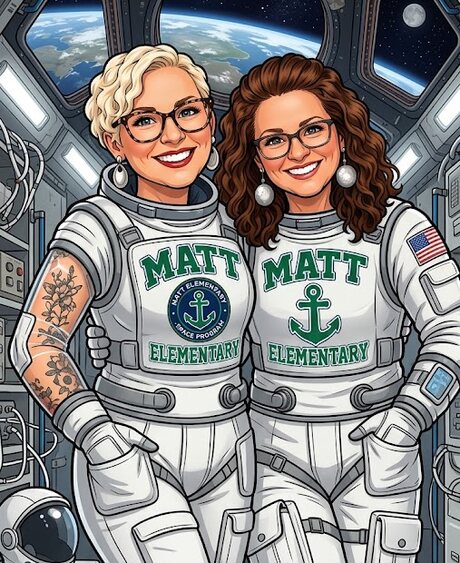
Scientists are finishing our space unit and reviewing stars, planets, orbit, rotation, moon phases, and the Earth–moon–sun system. The space unit final test is Friday, October 9.
🌙 Tonight’s sky challenge: step outside, sketch the moon’s shape, and ask your child to name the phase. Bonus mission: explain why the moon seems to change shape even though it stays round!
💬 FAMILY TALKING POINTS — ASK ME SOMETHING FUN!
Skip “What did you do at school today?” and try one of these instead. There are no one-word answers here!
Make it a game: let your child choose one card, then let them ask the grown-ups a question too!
- MON OCT 5 — PTO Fun Run kickoff 🏃
- FRI OCT 9 — Revolutionary War battles quiz, I Survived unit summative, and space unit final test 📝
- MON OCT 12 — Vocabulary and morphology assessment 🔤
- TUE OCT 13 — Quarter 1 grading window closes 📊
- WED OCT 14 — SOAR bus safety during school 🚌
- SAT OCT 17 — Red, White & Boo 5K · 8:30 AM at Liberty Middle School
- MON OCT 19 — No school
- WED OCT 21 — Picture retakes 📸
- FRI OCT 23 — 50th day of school celebration 🎉
- TUE OCT 27 — North United Trunk or Treat
- SUN NOV 1 — Matt Glow Run · 5K at 5:00 PM and Fun Run at 5:45 PM
Monday, October 5 starts on Red Day: Mrs. Wahlstrom’s class has Computer Science, and Mrs. Henderson’s class has PE. The complete daily rotation is below.
Hello, Mariner Families! This is a big week of showing what we know — three assessments, spaced out on purpose so no day feels heavy. We open with a social studies quiz Monday, our mathematicians finish Module 1 with their assessment Wednesday, and our readers take the formative assessment for our I Survived the American Revolution unit on Thursday. The good news: the study guide and a review game for the reading formative are both linked right here ⬇️, so studying can happen a little at a time all week instead of all at once. In between, we keep going — the novel continues, our historians stay in the Revolutionary War, and our scientists head into the moon and space. Also worth a note: the Fall Into Reading Challenge ends Friday, and Fall Break starts the following Monday. 💙
✅ QUIZZES & ASSESSMENTS THIS WEEK
- Monday, September 21 — Social Studies quiz over what we have been studying in our Revolutionary War unit: taxation and Britain's control over the colonies, the Stamp Act, the Boston Tea Party, and why being taxed without representation felt so unfair. The notes your child has taken in class are the study guide for this one — reading back through them Sunday evening is the whole review.
- Wednesday, September 23 — Math Module 1 assessment. This one closes out the entire module: place value, comparing and rounding multi-digit numbers, and multi-digit addition and subtraction.
- Thursday, September 24 — Reading unit formative assessment for I Survived the American Revolution. This is the date we promised last week, and now it is official. 📝
📄 The study guide and a review game for Thursday's reading formative are linked in the reading section just below. ⬇️ Fifteen minutes here and there across the week beats any cram session the night before — and the learning targets are the study guide. 💙
📘 READING — CONTINUING I SURVIVED THE AMERICAN REVOLUTION · FORMATIVE THURSDAY
We are deep into our I Survived the American Revolution unit, and it keeps doing exactly what we hoped: while our historians study taxation and the tension between Great Britain and the colonies, our readers are living it through a character caught in the middle of it. Every reading discussion this week makes the social studies work stronger, and the other way around.
Our readers are still doing that grown-up thinking — looking closely at how sentences are built, naming the techniques the author chose, tracking how the protagonist and antagonist drive the conflict, hunting figurative language, and finding clues about when and where a text was written.
These six learning targets are exactly what Thursday's formative covers — they are written in student language, the same way your child hears them in class. If your child can explain one in their own words and give an example, they have it:
Our unit slides are open to families — the same ones we teach from in class, if you would like to see the examples behind each target.
🎯 STUDY TOOLS FOR THURSDAY'S FORMATIVE
Two things are ready for your reader to use before Thursday. The study guide walks through everything the formative asks for, and the review game turns that same material into practice your child will actually want to do. Both are posted now, so there is no need to wait until Wednesday night.
Both links open in a new tab and can be used as many times as your child likes. If a link will not open on a school device, try it from a phone or a home computer — and please send us a message in TalkingPoints if you have any trouble at all. 💙
🔤 MORPHOLOGY — NEW FOCUS THIS WEEK · THE PREFIX MID-
We are moving on from pre- to a new prefix this week: mid-, which means “middle” or “in the middle of.” This one is a gift, because it does the same job every single time and it is hiding in words students already say — midnight, midday, midfield. Once they hear “middle” inside the word, they can work out a word they have never seen before, which is the whole goal of morphology.
The full vocabulary list for this unit lives on our vocabulary slides — a quick look before Thursday is time well spent.
✏️ WRITING — STILL IN THE AUTHOR'S CHAIR · AUDIENCE, TASK & PURPOSE
Writing continues right alongside the novel. Students keep analyzing and using the techniques authors choose to convey ideas and shape meaning — and every skill is practiced using I Survived the American Revolution, 1776, the same book they are reading, so the two subjects keep feeding each other.
Our anchor work is still strong, deliberate sentences, layered with the three questions we ask before writing anything at all:
Our writing slides are open to families too — the full lesson-by-lesson path is also on the What We're Learning page.
➗ MATH — FINISHING MODULE 1 · MODULE ASSESSMENT WEDNESDAY, SEPTEMBER 23
We are finishing Module 1 this week. Monday and Tuesday are for wrapping up, reviewing, and answering the last questions, and then the Module 1 assessment is Wednesday, September 23. Everything on it is work your child has already done in class — this is the module coming full circle, not new material.
What the module assessment pulls together:
The best five-minute study session at home, any night this week: write down one addition problem, one subtraction problem with zeros in it, and one number to round. Have your child solve them, then ask “now explain that to me like I have never seen it before.” If they can teach it, they are ready. 💙
🔭 SCIENCE — THE MOON & SPACE · ORBIT, ROTATION & MOON PHASES
Our scientists move further into the moon and space. After comparing stars and planets, we are now modeling how the Earth and moon move in relation to the sun — and using those models to explain things students have noticed their whole lives: day and night, the seasons, and why the moon keeps changing shape.
Standards we are working in: S4E1 — compare and contrast the physical attributes of stars and planets. S4E2 — model the effects of the position and motion of the Earth and the moon in relation to the sun, as observed from the Earth.
This is the one unit where the homework is looking up. Step outside a few nights this week and sketch the moon. Those real observations are exactly what we build our moon phase models from in class. 🌙
🌎 SOCIAL STUDIES — QUIZ MONDAY, THEN ONWARD IN THE REVOLUTIONARY WAR
Monday opens with our quiz on what we have studied so far — taxation, how Great Britain's control over the colonies created tension, the Stamp Act, the Boston Tea Party, and the big idea underneath all of it: being taxed by a government you have no voice in. Last week's Tax Day made that feeling very real, and students should lean on it — that frustration is the answer to half the quiz.
The best way to prepare: have your child read back through their class notes and then teach you one thing from them. Three or four minutes of that is worth more than an hour of rereading.
After the quiz we keep going in our Revolutionary War unit. The colonists have tried petitions and protests; now we follow what happened as the disagreement grew past taxes and turned into a fight for independence — and every bit of it shows up in the novel our readers are holding. 🇺🇸
- Reading — Open the study guide and review game above. Fifteen minutes on each, spread across the week, is a complete study plan for Thursday.
- Reading — Read the six learning targets out loud, one a night. Can your child explain it in their own words and give an example from the novel? Then they are ready.
- Reading — Keep hyperbole hunting and personification spotting in everyday talk: “I'm starving,” “the wind whispered,” “my phone died.”
- Word Study — Play “mid- means middle”. How many mid- words can you collect in one day — midnight, midday, midweek, midair? Then try inventing one: what would mid-movie mean?
- Social Studies — Sunday night: “Teach me one thing from your Revolutionary War notes.” That is the whole review for Monday's quiz.
- Math — Before Wednesday: one addition problem, one subtraction problem with zeros, one number to round — then “explain it to me.”
- Science — Sketch the moon a few nights this week and label it: is the lit part growing (waxing) or shrinking (waning)?
- Reading Challenge — Friday is the last day of the Fall Into Reading Challenge. Every minute still counts — log them all!
📚 LAST WEEK TO READ & LOG · 25–35 MINUTES A NIGHT
Our school-wide Fall Into Reading Challenge ends Friday, September 25. This is the home stretch — every minute logged this week still counts toward both an individual prize and our classroom goals. Reading the novel for class counts. A comic counts. Being read to counts!
How to log minutes — it takes about 20 seconds:
- Log into your child's ClassLink account
- Select the Beanstack app
- Record the daily minutes
Please log any minutes you have not entered yet. Minutes that never make it into Beanstack cannot count toward a prize, and we would hate for your reader to miss one they already earned. 💙
🏆 INDIVIDUAL PRIZE GOALS
Candy
Pencil & cool eraser
Slime
Squishy
🎉 CLASSROOM GOALS — WE WIN THESE TOGETHER
before Fall Break!
This is the week that decides the pizza party. 🍕 If everyone reads their 25–35 minutes and logs it before Friday, we get there.
🍂 FALL BREAK — SEPTEMBER 28 – OCTOBER 2 · STARTS RIGHT AFTER THIS WEEK
Fall Break is September 28 – October 2, which means Friday, September 25 is our last day before the break. School resumes Monday, October 5. Please send in any missing work or forms before Friday so nothing sits in a backpack for a week. 🎒
📔 YEARBOOKS ARE ON SALE — ORDER EARLY!
2027 yearbooks are available now, and the longer you wait, the more expensive they get! Ordering early locks in the lowest price and makes sure your child's copy is reserved.
🥧 JOIN THE PTO — WIN A PIE IN THE FACE!
Our PTO membership drive is still going, and the winning class gets to pie their teacher in the face! Memberships fund events, supplies, and staff appreciation all year long. Help our class win!
Specials meet 8:10 – 8:55 AM every day on an 8-day color rotation. Each day's color is the same for both classes, but the two classes visit different specials on that color — find your teacher's line in each box. This week we start on Day 7 Violet, Monday, September 21, and the rotation comes back around to Day 1 Red on Wednesday.
Grey days have no specials. September 28 – 30 is Fall Break. The rotation is not skipped — it pauses, so a color is never missed, and we pick right back up when we return in October.
- MON SEP 21 — Social Studies quiz · taxation, the Stamp Act & the Boston Tea Party 🌎
- WED SEP 23 — Math Module 1 assessment · finishes the module ➗
- THU SEP 24 — Reading unit formative assessment · I Survived the American Revolution 📝
- FRI SEP 25 — Fall Into Reading Challenge ends · last day to log minutes in Beanstack 🍂
- FRI SEP 25 — Last day before Fall Break 🎒
- NOW OPEN — Yearbook orders · prices go up the longer you wait 📔
- ALL YEAR — Join the PTO · help our class win the pie-in-the-face 🥧
- SEP 28 – OCT 2 — Fall Break · school resumes Monday, October 5 🍂
Hello, Mariner Families! This is one of our favorite weeks of the year. Our readers start a brand-new reading unit — we are reading I Survived the American Revolution, which ties directly into the Revolutionary War unit our historians are already living in. Reading and social studies will be telling the same story from two directions all unit long. In writing we step into the author's chair and ask who our audience is, what our task is, and what our purpose is. Our mathematicians move into multi-digit addition and subtraction with a quiz Friday, and our scientists keep exploring stars, planets, orbit and rotation. And on Tuesday, September 15 — brace yourselves — Mrs. Wahlstrom and Mrs. Henderson become the queens of the classroom and start taxing everything. 👑 Everything you need is right here. 💙
✅ QUIZZES & ASSESSMENTS THIS WEEK
- Friday, September 18 — Math quiz over multi-digit addition and subtraction
- Coming in about a week and a half — our ELA formative assessment for the new I Survived the American Revolution unit. We will announce the exact date as we get into the unit, and it will be posted here and in TalkingPoints as soon as we set it.
Nothing to cram for this week — the learning targets below are the study guide. Talking through one target a night is honestly the best preparation there is. 💙
📘 READING — NEW UNIT! I SURVIVED THE AMERICAN REVOLUTION
We are starting our second reading unit of the year, and it is a perfect match for what we are already studying: I Survived the American Revolution. While our historians dig into taxation and the tension between Great Britain and the colonies, our readers get to feel what that was like through a character living through it. Students will be surprised how often something they read in the novel explains something they learned in social studies — and the other way around.
This unit asks readers to do some grown-up thinking: look closely at how sentences are built, notice the techniques the author chose, track the protagonist and antagonist and how they create the conflict, hunt for figurative language, find clues about when and where a text was written, and ask their own deep questions about things they want to know more about.
Our learning targets for this unit — these are written in student language, exactly how your child hears them in class:
Want to see exactly what we are doing? Our unit slides are open to families — the same ones we teach from in class.
🔤 MORPHOLOGY — THE PREFIX PRE-
Our word study focus for this unit is the prefix pre-, which means “before.” Once students own that one small piece, a whole shelf of words cracks open — because the prefix does the same job every single time.
The full vocabulary list for this unit lives on our vocabulary slides — please peek at it, the words show up everywhere once you know them.
✏️ WRITING — WRITING LIKE AN AUTHOR · AUDIENCE, TASK & PURPOSE
In our writing space this unit, students analyze and use different techniques to convey ideas, shape meaning, and join a conversation through their writing. In other words: we stop writing “to finish the assignment” and start writing like authors who made choices on purpose.
Our anchor work is still sentence structure — strong, complete, deliberate sentences — layered with the three questions we now ask before we write anything at all:
Our writing slides are open to families too, if you would like to see the examples we work through together.
➗ MATH — MULTI-DIGIT ADDITION & SUBTRACTION · QUIZ FRIDAY, SEPTEMBER 18
Our mathematicians are moving into multi-digit addition and subtraction. Students add and subtract large numbers using the standard algorithm, and — the part fourth grade cares most about — they explain why it works using place value. Regrouping stops being a trick you memorize and starts being something that makes sense.
The quiz is Friday, September 18. The best five-minute study session at home: write down one addition problem and one subtraction problem, have your child solve them, and then ask “now explain the regrouping to me like I've never seen it.” If they can teach it, they have it.
🔭 SCIENCE — CONTINUING OUR NEW UNIT · STARS, PLANETS, ORBIT & ROTATION
Our scientists are continuing the unit we just started, comparing stars and planets and then modeling how the Earth and moon move in relation to the sun. This is the unit that finally explains things students have noticed their whole lives — day and night, the seasons, and why the moon keeps changing shape.
Standards we are working in: S4E1 — compare and contrast the physical attributes of stars and planets. S4E2 — model the effects of the position and motion of the Earth and the moon in relation to the sun, as observed from the Earth.
🌎 SOCIAL STUDIES — TAXATION, CONTROL & THE ROAD TO REVOLUTION
We are continuing the causes of the Revolutionary War, and this week we get to the heart of it: taxation, and how Great Britain's control over the colonies created tension. After the French and Indian War left Britain deeply in debt, Parliament looked across the ocean and decided the colonists should help pay for it — without ever asking them. That single decision is where “no taxation without representation” comes from.
What we are digging into:
- The Stamp Act — a tax on nearly every piece of printed paper in the colonies: newspapers, contracts, even playing cards.
- Other taxes and acts that tightened Britain's control over colonial trade and daily life.
- The Boston Tea Party — what colonists did when petitions and protests did not work.
- The big idea — why being taxed by a government you have no voice in felt so unfair that people were willing to fight over it.
This is also where reading and social studies shake hands: everything students learn here shows up in I Survived the American Revolution.
👑 TAX DAY — TUESDAY, SEPTEMBER 15 · THE QUEENS OF THE CLASSROOM
On Tuesday, September 15, Mrs. Wahlstrom and Mrs. Henderson become the queens of the classroom — and we will be taxing students for the things they need and use all day long. A tax to use a pencil. A tax to sit in your chair. A tax on the paper you need for the assignment we just assigned you. 😄
We know exactly how this goes, because it goes this way every year: it starts out funny, and then it gets genuinely outrageous — and that is the whole point. Students will feel the frustration of being taxed by someone who never asked their opinion, and that feeling is something no worksheet can teach. By the end of the day they understand the colonists better than any textbook could explain.
Please expect some very indignant storytelling at dinner on Tuesday. 👑 Ask your child what they got taxed for, how much they “paid,” and whether they thought it was fair. Then ask the big one: “So what could you actually do about it?” That question is the American Revolution.
- Reading — Read the six learning targets above out loud together. One a night, explained in your child's own words, is a perfect study routine for the formative.
- Reading — Go hyperbole hunting. “I'm starving!” “This backpack weighs a thousand pounds!” Families speak in hyperbole constantly — point them out and laugh about them.
- Reading — Try personification out loud: the wind whispered, the car groaned, the phone died. Ask, “can a phone really die?”
- Reading — Ask: “Who is the protagonist? Who or what is working against them?” It works on the novel, a movie, or a video game.
- Word Study — Play “pre- means before”. How many pre- words can you find on a menu, a food label, or an oven?
- Writing — Before your child writes anything this week, ask the three author questions: who is my audience, what is my task, what is my purpose?
- Social Studies — Try Tax Day at home! Tax the TV remote. Tax dessert. See how fast someone demands representation. 😄
- Math — Two problems a night, then: “explain the regrouping to me.” That is the whole quiz, right there.
- Science — Keep sketching the moon a few nights a week. Those real observations are what we build our moon phase model from.
📚 READ 25–35 MINUTES A NIGHT · LOG IT IN BEANSTACK
Our school-wide Fall Into Reading Challenge runs September 18–25. The goal is 25–35 minutes of reading per night, and every minute counts toward both an individual prize and our classroom goals. Reading the novel for class counts. Reading a comic counts. Being read to counts!
How to log minutes — it takes about 20 seconds:
- Log into your child's ClassLink account
- Select the Beanstack app
- Record the daily minutes
🏆 INDIVIDUAL PRIZE GOALS
Candy
Pencil & cool eraser
Slime
Squishy
🎉 CLASSROOM GOALS — WE WIN THESE TOGETHER
before Fall Break!
Every single minute your child logs pushes the whole class closer. If everyone reads their 25–35 minutes and logs it, pizza is absolutely within reach. 🍕
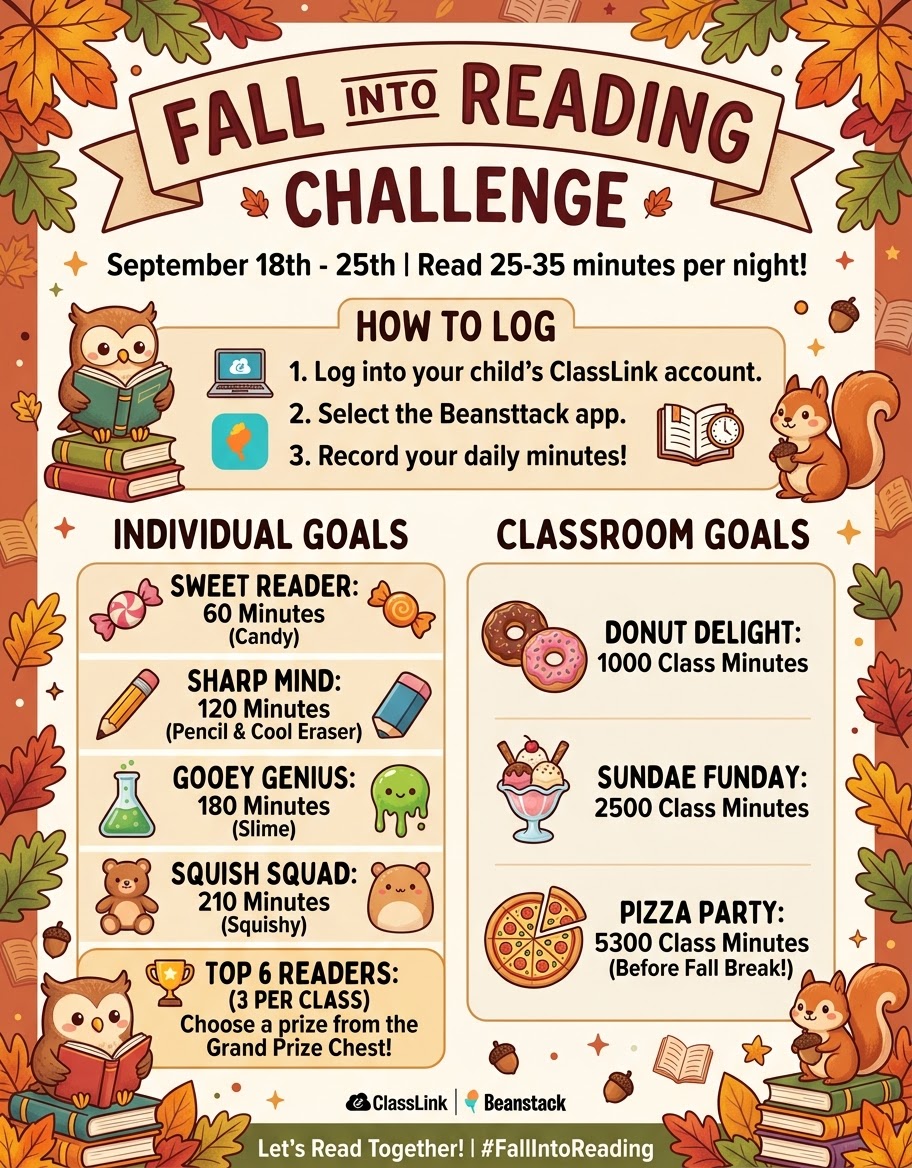
🛒 OUR CLASSES SHOP DURING SPECIALS
It is our week! Both classes get their own shopping time during specials. Please send money or set up an eWallet ahead of your child's day — and if your child is not shopping, no problem at all, they will still get to browse with their class.
during specials
during specials
Perfect timing, too — the Fall Into Reading Challenge starts Friday, so a brand-new book from the Book Fair is exactly the right fuel. 📚
📔 YEARBOOKS ARE ON SALE — ORDER EARLY!
2027 yearbooks are available now, and the longer you wait, the more expensive they get! Ordering early locks in the lowest price and makes sure your child's copy is reserved.
🥧 JOIN THE PTO — WIN A PIE IN THE FACE!
Our PTO membership drive is still going, and the winning class gets to pie their teacher in the face! Memberships fund events, supplies, and staff appreciation all year long. Help our class win!
🍂 FALL BREAK IS COMING — SEPTEMBER 28 – OCTOBER 2
Fall Break is September 28 – October 2. It is closer than it feels! Note that our Pizza Party reading goal has to be reached before Fall Break, so those logged minutes matter now. 🍕
Specials meet 8:10 – 8:55 AM every day on an 8-day color rotation. Each day's color is the same for both classes, but the two classes visit different specials on that color — find your teacher's line in each box. This week we start on Day 2 Orange, Monday, September 14.
Grey days have no specials. September 28 – 30 is Fall Break. The rotation is not skipped — it pauses, so a color is never missed. Book Fair class shopping happens during specials on Wednesday, September 16 (Mrs. Henderson) and Friday, September 18 (Mrs. Wahlstrom).
- MON SEP 14 — New reading unit begins · I Survived the American Revolution 📘
- TUE SEP 15 — TAX DAY! The queens of the classroom start taxing everything 👑
- WED SEP 16 — Mrs. Henderson's class shops the Book Fair · during specials 🛒
- FRI SEP 18 — Math quiz · multi-digit addition & subtraction ➗
- FRI SEP 18 — Mrs. Wahlstrom's class shops the Book Fair · during specials 🛒
- SEP 18 – 25 — Fall Into Reading Challenge · 25–35 minutes a night, logged in Beanstack 🍂
- DATE COMING SOON — ELA formative assessment · about a week and a half out, exact date to be announced 📝
- NOW OPEN — Yearbook orders · prices go up the longer you wait 📔
- ALL YEAR — Join the PTO · help our class win the pie-in-the-face 🥧
- SEP 28 – OCT 2 — Fall Break 🍂
Hello, Mariner Families! We hope you had a wonderful long weekend. This is a four-day week — there is no school Monday, September 7 for Labor Day, and we return Tuesday, September 8. It is a big week: our readers review every ELA skill we have worked on this whole unit and then take their summative test across two days, our historians take an open-notes quiz on the French and Indian War, our scientists blast off into a brand-new unit on stars, planets, orbit and rotation, and our mathematicians keep going with rounding. Plus — Curriculum Night is Thursday, September 10, and the Book Fair will be open for you to shop. Everything you need is right here. 💙
✅ QUIZZES & ASSESSMENTS THIS WEEK
- Wednesday, September 9 — Social Studies quiz over the causes and consequences of the French and Indian War. This quiz is OPEN NOTES — students may use the notes they have taken in class, so having organized, complete notes is the very best way to prepare.
- Thursday, September 10 — ELA summative test · Part 1 (on the computer)
- Friday, September 11 — ELA summative test · Part 2 (on the computer)
Why the ELA test is split into two days: when students took the formative version, it took them a long time to finish, and we do not want anyone rushing through their best thinking. So we are adjusting the plan and splitting the summative over Thursday and Friday. Students will have plenty of time, work in shorter stretches, and get a fresh start on the second half. Nothing extra to study for the second day — it is the same test, just spread out. 💙
📄 The study guide and a review game for the test are linked in the ELA section just below. ⬇️
📘 ELA — REVIEW WEEK BEFORE OUR SUMMATIVE TEST
This week is all about review. We are going back through every skill we have been digging into all unit long — word parts, narrative techniques, characters, conflict, and theme — so that everything is fresh and connected before the summative test on Thursday and Friday.
These are exactly the learning targets the test covers. Reading them out loud with your child is a great study session all by itself — if they can explain a target in their own words and give an example, they are ready.
Quick ways to review at home:
- Pick any word from a book and break it apart — what's the root, and what got added to the front or the end?
- Ask: “Who is the protagonist? Who or what is working against them? How does that create the problem in the story?”
- Ask: “What did the character do, say, and feel — and what lesson does that add up to?” That is theme.
- Talk about a show or movie the same way. The skills are identical, and it counts as studying!
🎯 STUDY TOOLS FOR THE ELA SUMMATIVE
Two things are ready for your reader to use before Thursday — the study guide covers everything the test asks for, and the review game turns it into practice. Fifteen minutes on each is a great week of studying.
Both links open in a new tab and can be used as many times as your child likes. If a link will not open on a school device, try it from a phone or home computer — and send us a message in TalkingPoints if you have any trouble at all. 💙
➗ MATH — STAYING WITH MODULE 1, TOPIC C · ROUNDING MULTI-DIGIT NUMBERS
Math is staying the same this week. We are still in Topic C: Rounding Multi-Digit Whole Numbers — rounding to the nearest ten, hundred, thousand, ten thousand, and hundred thousand, and explaining why a number rounds the way it does using a vertical number line and place value reasoning.
The Topic C family letter came home in the take-home folder — it is the best one-page guide to what we are practicing. Keep asking the question we ask all week: “Which one is it closer to, and how do you know?”
🔭 SCIENCE — NEW UNIT! STARS, PLANETS, ORBIT & ROTATION
Our scientists are starting a brand-new unit and heading out into space. We are moving into orbit and rotation — comparing stars and planets, then modeling how the Earth and the moon move in relation to the sun. This unit is a favorite: it explains things students see every single day (day and night, the seasons, the shape of the moon) and finally answers why.
Part 1 · Stars & Planets (S4E1) — Obtain, evaluate, and communicate information to compare and contrast the physical attributes of stars and planets.
- Ask questions to compare and contrast technological advances that have changed the amount and type of information we can gather about distant objects in the sky.
- Construct an argument for why some stars — including our own sun — look bigger or brighter than others.
- Construct an explanation of the differences between stars and planets.
- Evaluate the strengths and limitations of models of our solar system in showing relative size, order, appearance, and composition of the planets and the sun.
Part 2 · Earth, Moon & Sun (S4E2) — Obtain, evaluate, and communicate information to model the effects of the position and motion of the Earth and the moon in relation to the sun, as observed from the Earth.
- Develop a model to explain why the length of day and night changes throughout the year.
- Develop a model, based on observations, of the repeating pattern of the moon's phases — new, crescent, quarter, gibbous, and full.
- Construct an explanation of how the Earth's orbit and its consistent tilt cause the seasons.
Words we will be using all unit — hearing them at home helps enormously:
🌎 SOCIAL STUDIES — QUIZ WEDNESDAY · THE FRENCH AND INDIAN WAR (OPEN NOTES)
We are continuing our Revolutionary War unit, and our quiz is Wednesday, September 9 over the causes and consequences of the French and Indian War — the conflict that set everything else in motion.
This quiz is OPEN NOTES. Students may use the notes they have taken in class. That makes organized, complete notes the single most valuable thing to have ready — please help your child check that their notes are in their binder and easy to read.
What the quiz covers:
- Causes — why Great Britain and France both wanted the same land, and how competition over the Ohio River Valley and the fur trade turned into war.
- Consequences — how the war changed who controlled land in North America, the enormous debt Britain was left with, and why Britain then started taxing the colonists.
- The big connection — how those new taxes and rules led straight to colonial frustration and, eventually, the Revolutionary War.
Great question to ask at home: “The war ended — so why were the colonists more upset afterward, not less?” If your child can answer that, they understand the heart of this standard.
- Reading — Read the five learning targets above out loud together. Have your child explain each one in their own words and give one example from any book or movie.
- Reading — Play “break the word apart” with any long word you spot on a sign, a menu, or a cereal box.
- Reading — Work through the ELA study guide, then let your child loose on the ELA review game. 🎮
- Social Studies — Help your child organize their notes before Wednesday. Open notes only helps if you can find the answer fast!
- Science — Go look at the moon a few nights this week and sketch its shape. You are collecting real observations for our moon phase model.
- Science — Spin around slowly with a lamp in the room: facing the lamp is day, facing away is night. That is rotation, and it is a great 30-second demo.
- Math — Round the total on a receipt to the nearest ten, hundred, and thousand. Ask: which is it closer to, and how do you know?
⭐ “STARS, STRIPES & STANDARDS” — WE HOPE TO SEE YOU THERE!
Join us for Curriculum Night on Thursday, September 10 from 5:00 to 6:30 PM. Come hear about 4th grade curriculum expectations, academic standards, classroom routines, and what it means to be a Mariner every day. This year's Red, White & Blue edition celebrates the partnership between home and school — because Red, White & Blue… we need you!
🏫 HOMEROOM ACADEMIC SESSIONS — PICK ONE
Please choose one session to visit your child's homeroom, hear about the curriculum for the year, and get to know us better. All three sessions cover the same information, so pick whichever fits your evening best.
🕟 PRE-EVENT MEETINGS · 4:30 – 5:00 PM
- Gifted Parent Meeting — in the Cafeteria, 4:30 – 5:00 PM (for students already enrolled in the Gifted program)
- ESOL Parent Meeting — in Professional Learning Room 704, 4:30 – 5:00 PM
🚶 OPEN CAMPUS ACTIVITIES — VISIT BETWEEN HOMEROOM SESSIONS
Please make time to walk around! There is a lot happening between the homeroom sessions.
🎟️ DON'T MISS THE RAFFLE!
Throughout the evening your family can earn raffle tickets and enter prize drawings — and the more activities you visit, the more chances you have. Some of the prizes:
- ⭐ A FREE yearbook
- ⭐ A Matty plush
- ⭐ A book from the book vending machine
- ⭐ Lunch with the principal
- ⭐ And more!
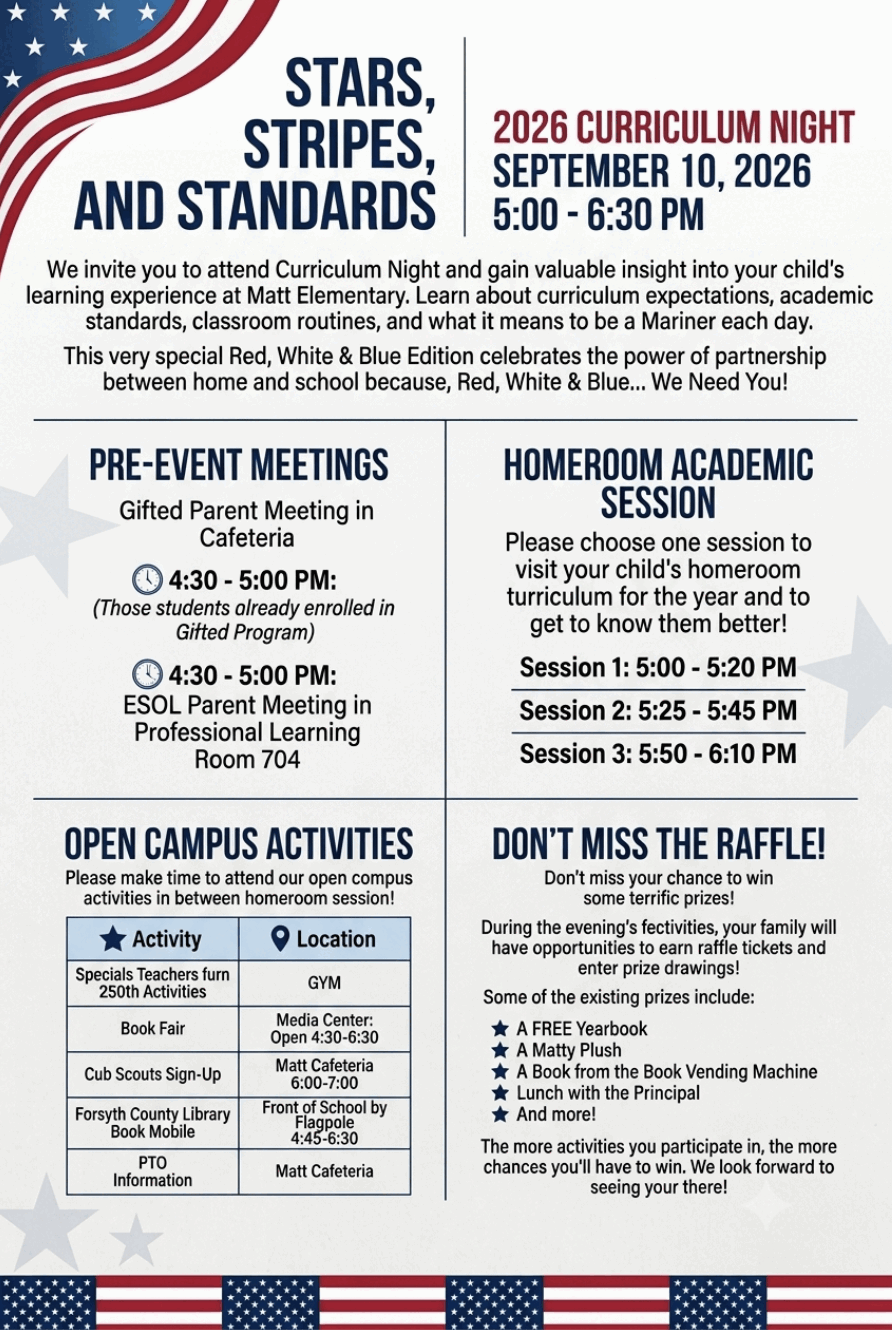
🛍️ PARENTS SHOP AT CURRICULUM NIGHT · THURSDAY, SEPTEMBER 10
The Book Fair is open in the Media Center from 4:30 to 6:30 PM on Curriculum Night so families can browse and shop. It is a wonderful chance to pick out books together — and shopping with your child means they get books they are genuinely excited to read.
🛒 OUR CLASSES SHOP DURING SPECIALS
Both classes get their own shopping time during specials. Please send money or set up an eWallet ahead of your child's day:
during specials
during specials
If your child is not shopping, no problem at all — they will still get to browse with their class.
🎉 LABOR DAY — NO SCHOOL MONDAY, SEPTEMBER 7
There is no school Monday, September 7. We start our four-day week on Tuesday, September 8.
📔 YEARBOOKS ARE ON SALE — ORDER EARLY!
2027 yearbooks are available now, and the longer you wait, the more expensive they get! Ordering early locks in the lowest price and makes sure your child's copy is reserved. (And one lucky family will win a free one at the Curriculum Night raffle!)
🥧 JOIN THE PTO — WIN A PIE IN THE FACE!
Our PTO membership drive is still going, and the winning class gets to pie their teacher in the face! Stop by the PTO table in the cafeteria at Curriculum Night or join online — memberships fund events, supplies, and staff appreciation all year long. Help our class win!
Specials meet 8:10 – 8:55 AM every day on an 8-day color rotation. Each day's color is the same for both classes, but the two classes visit different specials on that color — find your teacher's line in each box. This week we pick back up on Day 6 Indigo, Tuesday, September 8.
Grey days have no specials. Monday, September 7 is Labor Day and September 28 – 30 is Fall Break. The rotation is not skipped — it pauses, so Day 6 Indigo lands on Tuesday, September 8. Book Fair class shopping happens during specials on Wednesday, September 16 (Mrs. Henderson) and Friday, September 18 (Mrs. Wahlstrom).
- MON SEP 7 — Labor Day — No School 🎉
- AVAILABLE NOW — ELA study guide and ELA review game for the summative 🎯
- WED SEP 9 — Social Studies quiz · French & Indian War · open notes 🌎
- THU SEP 10 — ELA summative test · Part 1 📝
- THU SEP 10 — Curriculum Night · 5:00 – 6:30 PM 🌙
- THU SEP 10 — Book Fair open for parents · Media Center 4:30 – 6:30 📚
- FRI SEP 11 — ELA summative test · Part 2 📝
- WED SEP 16 — Mrs. Henderson's class shops the Book Fair · during specials 🛒
- FRI SEP 18 — Mrs. Wahlstrom's class shops the Book Fair · during specials 🛒
- NOW OPEN — Yearbook orders · prices go up the longer you wait 📔
- ALL YEAR — Join the PTO · help our class win the pie-in-the-face 🥧
- SEP 28 – OCT 2 — Fall Break 🍂
Hello, Mariner Families! This is a big week in Rooms 803 & 804. Our scientists wrap up simple machines and force & motion, our mathematicians move into rounding multi-digit numbers, our readers finish Alvin Ho, and our historians step back in time to begin the Revolutionary War. There are three things to study for this week, so we have put everything you need right here — including the full Alvin Ho study guide.
✅ QUIZZES & ASSESSMENTS THIS WEEK
- Tuesday, September 1 — Reading vocabulary & morphology quiz over Alvin Ho (study guide is below — words, meanings, and suffix rules)
- Thursday, September 3 — Science vocabulary quiz over Force & Motion
- Thursday, September 3 — Alvin Ho reading assessment (our first reading test of the year, taken on the computer)
Heads up: Thursday, September 3 is a full day! It is Picture Day plus two assessments. A good night's sleep Wednesday and a few minutes of review each evening will go a long way. 💙
➗ MATH — MODULE 1, TOPIC C · ROUNDING MULTI-DIGIT NUMBERS
We are moving into Topic C: Rounding Multi-Digit Whole Numbers. Students round to the nearest ten, hundred, thousand, ten thousand, and hundred thousand — and, just as importantly, they explain why a number rounds the way it does using a vertical number line and place value reasoning.
Ask your child the question we ask all week: “Which one is it closer to, and how do you know?” Explaining the thinking out loud is the part that makes rounding stick.
💌 MATH FAMILY LETTER — COMING HOME MONDAY
A new family letter for Topic C goes home Monday, August 31. Please check your child's take-home folder! It explains the rounding standards in plain language and lists quick, easy ways to practice at home — it is the best one-page guide to what we are working on.
🔬 SCIENCE — LAST WEEK OF SIMPLE MACHINES & FORCE AND MOTION
This is our final week of the simple machines and force & motion unit, so we are pulling it all together and reviewing everything we have learned about how forces make things move — and how the six simple machines make work easier.
🛝 Playground field study! Last Thursday, August 27, we took our learning outside and hunted for simple machines on the playground. Students found levers, inclined planes, wheels and axles, wedges, screws, and pulleys hiding in plain sight on equipment they play on every day. Pictures from our playground hunt are posted in TalkingPoints — go take a look, they were so proud of themselves!
Vocabulary quiz Thursday, September 3. Words we have been using all unit — a great place to start reviewing:
🏠 At-home activity: go on a simple machine hunt around your house! The activity and our playground pictures were sent home through TalkingPoints. Scissors, doorknobs, jar lids, staplers, wheelbarrows, ramps, faucet handles, and zippers are all excellent finds. Ask: which machine is it, and what job does it make easier?
📘 READING — FINISHING ALVIN HO
We finish Alvin Ho: Allergic to Girls, School, and Other Scary Things this week! Students will look back across the whole book — how Alvin changed, what he was afraid of, and how the author showed us who he is.
- Tuesday, September 1 — vocabulary & morphology quiz (study guide below ⬇️)
- Thursday, September 3 — Alvin Ho reading assessment, taken on the computer
🔤 ALVIN HO STUDY GUIDE — EVERYTHING ON TUESDAY'S QUIZ
Your child has a paper copy, but here it is too, so nothing gets lost in a backpack. The quiz covers suffixes and the vocabulary words from our novel.
Part 1 · Suffixes: -s/-es, -ed, -ing
box → boxes · wish → wishes · watch → watches
Use -es after x, sh, ch, s, or z
laugh → laughed · float → floated
the gathering storm (adjective)
the family gathering (noun)
Part 2 · Vocabulary Words
Part 3 · Tips for Studying
- ★ Cover the meaning and try to say it from memory, then check.
- ★ Use each word in your own silly sentence — it helps it stick!
- ★ Practice the suffix rules by finding -s/-es, -ed, and -ing words in any book you are reading.
- ★ Ask a family member to quiz you with the word list.
✏️ WRITING — WHAT WE LOVE TO WRITE & WHAT MAKES A SENTENCE
We are starting the week with a fun conversation: what do you like to write? Stories, comics, jokes, facts about animals, letters to family — knowing what our writers love helps us grow them all year.
Then we get to work on strong sentence writing. Students are asking two questions about every sentence they write:
1. Does my sentence have what a sentence needs? A capital letter to start, a who or what (subject), what they are doing (predicate), a complete thought, and end punctuation.
2. Can my sentence answer the 5 W's? The more of these a sentence answers, the more the reader can picture it.
Compare these two: “We went outside.” versus “On Thursday, our class went out to the playground to hunt for simple machines because we are finishing our science unit.” Same idea — one paints the picture. That is the upgrade we are practicing!
🌎 SOCIAL STUDIES — STARTING THE REVOLUTIONARY WAR
We begin a brand-new unit this week: the Revolutionary War! We are starting at the very beginning with two big questions:
- What caused the Revolutionary War? Why did the colonists become so frustrated with Great Britain — taxes passed without their say, “no taxation without representation,” the Boston Massacre, the Boston Tea Party, and the laws that followed.
- Who were the important people? The leaders, writers, soldiers, and everyday colonists whose choices shaped the war and the country that came out of it.
This unit is a favorite every single year — expect your child to come home with strong opinions about tea. 🫖
- Science — Do the simple machine hunt around your house (sent in TalkingPoints along with our playground pictures). Name each machine and the job it makes easier.
- Science — Quiz each other on the force & motion words above before Thursday.
- Math — Round the total at the bottom of a receipt to the nearest ten, hundred, and thousand. Ask: which is it closer to, and how do you know?
- Reading — Use the study guide above: cover the meanings, then quiz your reader out loud before Tuesday.
- Writing — Have your child tell you about their day in one sentence that answers who, what, where, when, and why.
- Social Studies — Ask: “If someone made a rule for you with no say from you at all, how would that feel?” That is exactly where the colonists started.
🌈 WEAR THE COLOR OF THE DAY · LAST WEEK, AUG 31 – SEP 4
This is the last week of our kindergarten friends' color theme. Our 4th graders have been fantastic big-buddy role models — when we wear the color too, it helps the kindergartners spot, name, and remember their colors all over the building. Totally optional, but a big deal to our littlest Mariners. 💛
Note that Thursday, September 3 is Yearbook Picture Day — dress for the camera that day!
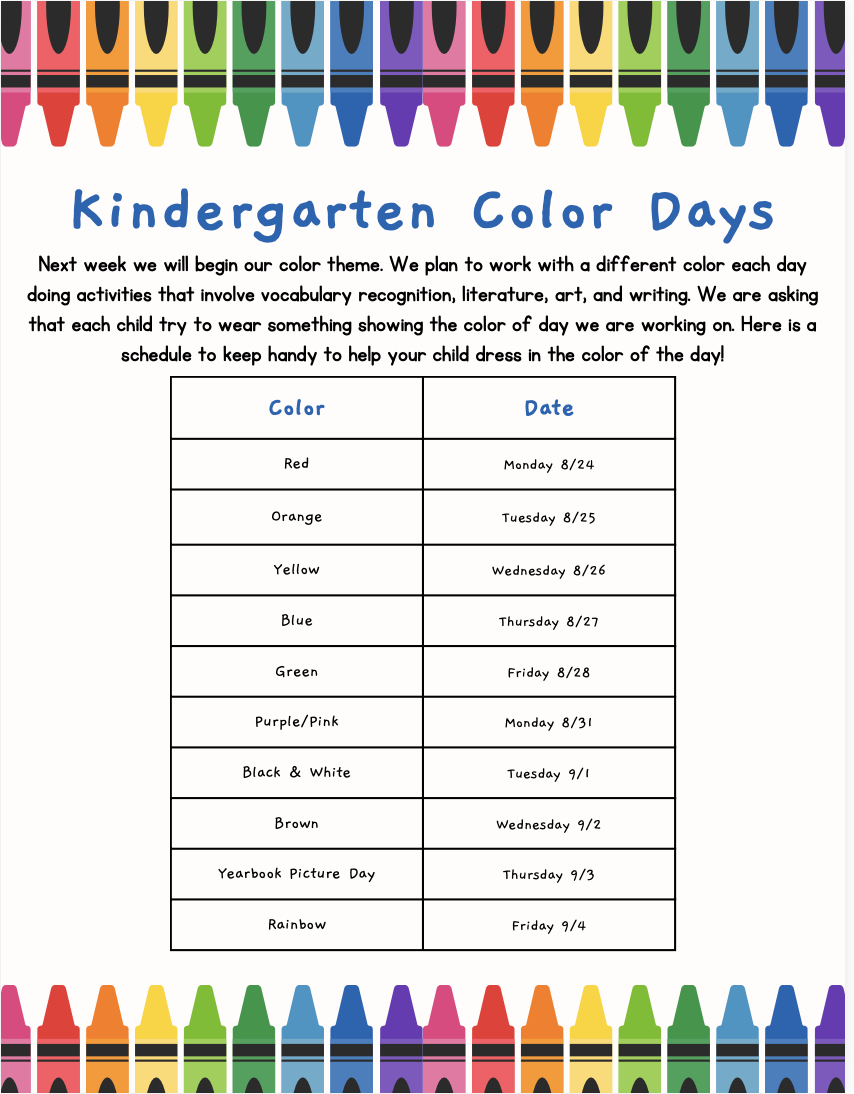
📸 YEARBOOK PICTURE DAY — THURSDAY, SEPTEMBER 3
Picture Day is Thursday, September 3. Order information came home ahead of the date — send it back with your student, or order online if you prefer. Smiles on, Mariners!
⏰ EARLY RELEASE — FRIDAY, SEPTEMBER 4 · DISMISSAL 11:50 AM
All grades (K–12) release early on Friday, September 4 at 11:50 AM. Please make sure we know your child's transportation plan for that day — a quick TalkingPoints message is perfect.
🎉 LABOR DAY — NO SCHOOL MONDAY, SEPTEMBER 7
Enjoy the long weekend! There is no school Monday, September 7. We are back Tuesday, September 8.
📔 YEARBOOKS ARE ON SALE — ORDER EARLY!
2027 yearbooks are available now, and the longer you wait, the more expensive they get! Ordering early locks in the lowest price and makes sure your child's copy is reserved.
🥧 JOIN THE PTO — WIN A PIE IN THE FACE!
Our PTO membership drive is still going, and the winning class gets to pie their teacher in the face! Memberships help fund events, supplies, and staff appreciation all year long. Help our class win!
Specials meet 8:10 – 8:55 AM every day on an 8-day color rotation. Each day's color is the same for both classes, but the two classes visit different specials on that color — find your teacher's line in each box.
Grey days have no specials. Friday, September 4 is an early release day (dismissal 11:50 AM), Monday, September 7 is Labor Day and September 28 – 30 is Fall Break. The rotation is not skipped — it pauses, so Day 6 Indigo moves to Tuesday, September 8.
- AUG 31 – SEP 4 — Kindergarten Color Days · final week, wear the color of the day 🌈
- MON AUG 31 — Math family letter goes home · Topic C, rounding 💌
- TUE SEP 1 — Reading vocabulary & morphology quiz · Alvin Ho 🔤
- THU SEP 3 — Science vocabulary quiz · Force & Motion 🔬
- THU SEP 3 — Alvin Ho reading assessment 📖
- THU SEP 3 — Yearbook Picture Day 📸
- FRI SEP 4 — Early Release · dismissal 11:50 AM ⏰
- MON SEP 7 — Labor Day — No School 🎉
- THU SEP 10 — Curriculum Night — more detail to come 🌙
- FRI SEP 11 — First reading summative test 📝
- NOW OPEN — Yearbook orders · prices go up the longer you wait 📔
- ALL YEAR — Join the PTO · help our class win the pie-in-the-face 🥧
- SEPTEMBER — Book Fair is coming! Details to come 📚
- SEP 28 – OCT 2 — Fall Break 🍂
Hello, Mariner Families! This week our mathematicians move into place value, our scientists get hands-on with the six simple machines, and our readers dig deeper into Alvin Ho. We also have one quiz on the calendar — social studies on Friday, August 28. Here is a look at the week.
✅ QUIZ THIS WEEK
- Friday, August 28 — Social Studies quiz on man-made features of the United States and the difference between man-made and physical features
The study guide is printed on the back of the physical features study guide your child already has — no new paper to hunt for! A few minutes of review each night is plenty.
➗ MATH — MODULE 1, LESSONS 8–12 · PLACE VALUE
We continue in Module 1, Lessons 8–12. Students are learning to read, write, and round multi-digit numbers to the hundred thousands place, and to move flexibly between the three ways we write a number:
Being able to switch between these three forms is what makes rounding and comparing large numbers click. Ask your child to say a number out loud, then write it every way they know!
💌 FAMILY LETTER — CHECK THE TAKE-HOME FOLDER
A family letter for this part of Module 1 is in your child's take-home folder. It explains the standards in plain language and lists simple tasks you can do at home to reinforce them. Please take a look when you get a chance — it is the best at-a-glance guide to what we are practicing.
🔬 SCIENCE — THE 6 SIMPLE MACHINES
Our study of simple machines continues. Students are learning what each machine is used for and how forces change when a simple machine is used to get a job done — sometimes a machine changes the direction of a force, and sometimes it changes how much force is needed.
Go on a simple machine hunt at home! Scissors, doorknobs, ramps, jar lids, flagpoles, and staplers are all great finds.
🌎 SOCIAL STUDIES — U.S. MAN-MADE FEATURES
We are focusing on the man-made features of the United States and describing how they are different from physical features. Man-made features are built by people (think the Statue of Liberty, the Golden Gate Bridge, the Erie Canal, Mount Rushmore); physical features are made by nature (mountains, rivers, lakes, deserts).
Quiz: Friday, August 28. The study guide is on the back of the physical features study guide. Locating features on a U.S. map at home is the best practice.
📘 READING — ALVIN HO CONTINUES
We are still reading Alvin Ho, and this week we look closely at how the author tells the story. Our focus:
- Narrative techniques — the moves an author makes to build characters, setting, and plot
- Asking questions — wondering before, during, and after reading, then hunting for the answers
- Dialogue — what characters say, and what their words tell us about who they are
- New vocabulary — collecting and using the words we meet in the text
🔤 MORPHEME MAGIC — THE SUFFIX -ING
This week's word part is the suffix -ing. Students are learning that -ing usually shows an action that is happening right now (Alvin is walking) — and that it can also turn an action into a naming word (the reading was hard). Ask your child to add -ing to a few verbs and notice which ones drop an e or double a consonant: hope → hoping, run → running.
- Math — Read a big number off a receipt, sign, or odometer. Say it in word form, then write it in expanded form.
- Math — Round prices to the nearest thousand or ten thousand while shopping online together.
- Science — Find all six simple machines around your house and talk about what each one makes easier.
- Social Studies — Flip through the study guide and sort each feature: made by people, or made by nature?
- Reading — While reading together, pause at dialogue and ask, “What does that tell us about this character?”
🌈 WEAR THE COLOR OF THE DAY · AUG 24 – SEP 4
Our kindergarten friends are starting their color theme, working with a different color each day through vocabulary, literature, art, and writing. Each kindergartner is asked to wear something in the color of the day.
Fourth graders, this is our chance to be great big-buddy role models! When our 4th graders wear the color too, it helps the kindergartners spot, name, and remember their colors all over the building. Totally optional — but so much fun, and a big help to our littlest Mariners. 💛
🧮 MATH TEAM TRYOUTS — WEDNESDAY, AUGUST 26 · 7:50 AM
Is your student interested in being on our Math Team? Tryouts are Wednesday, August 26 at 7:50 AM. Students should plan to arrive on time and ready to think! If your child would like to try out, please fill out the interest form below.
📔 YEARBOOKS ARE ON SALE — ORDER EARLY!
2027 yearbooks are available now, and the longer you wait, the more expensive they get! Ordering early locks in the lowest price and makes sure your child's copy is reserved.
🥧 JOIN THE PTO — WIN A PIE IN THE FACE!
Our PTO membership drive is still going, and the winning class gets to pie their teacher in the face! Memberships help fund events, supplies, and staff appreciation all year long. Help our class win!
Specials meet 8:10 – 8:55 AM every day on an 8-day color rotation. Each day's color is the same for both classes, but the two classes visit different specials on that color — find your teacher's line in each box.
- AUG 24 – SEP 4 — Kindergarten Color Days · wear the color of the day to support our K friends 🌈
- WED AUG 26 — Math Team tryouts · 7:50 AM 🧮
- FRI AUG 28 — Social Studies quiz · man-made vs. physical features 🌎
- NOW OPEN — Yearbook orders · prices go up the longer you wait 📔
- ALL YEAR — Join the PTO · help our class win the pie-in-the-face 🥧
- THU SEP 3 — Picture Day 📸 and first reading formative test
- THU SEP 4 — Early Release (dismissal 11:50 AM)
- MON SEP 7 — Labor Day — No School
- THU SEP 10 — Curriculum Night — more detail to come 🌙
- FRI SEP 11 — First reading summative test 📝
- SEPTEMBER — Book Fair is coming! Details to come 📚
Our classrooms run on the generosity of our families! If you are able to send in any of the items below, we would be so grateful. Donations are always optional and always appreciated. 💙
Hello, Mariner Families! We are settling into a great rhythm in Rooms 803 & 804. This week brings our first two quizzes of the year — math on Tuesday and social studies on Friday — along with continued work in Alvin Ho, our All About Me magazines, and force and motion. Here is everything you need to know.
✅ QUIZZES THIS WEEK
- Tuesday, August 18 — Math quiz on multiplicative comparison
- Friday, August 21 — Social Studies quiz on SS4G1: locating physical and human-made features of the United States
A little review at home goes a long way — ask your child to explain their thinking out loud!
📘 READING — Alvin Ho
We are continuing our novel study of Alvin Ho. Here is what your child is working toward, in their own words:
- I am learning to use what I know about how sentences are built to help me understand what I'm reading.
- I am learning to figure out how authors use storytelling techniques to help me understand the characters, where the story happens, and what's going on in the plot.
- I am learning to find sentences or words from what I read to prove my thinking.
- I am learning to come up with my own interesting questions about a topic I want to learn more about. I will ask questions that help me dig deeper and discover new things.
- I am learning to read informational texts and explain how the author organized their ideas and used facts to teach me about the main topic.
- I am learning to answer “Who is this written for?” and “How does the author show me their main point from beginning to end?”
- I am learning to figure out what kind of writing I'm reading (like stories, how-to guides, or persuasive articles) and explain how the writer chose that style to connect with their readers and get their message across.
📅 READING ASSESSMENT DATES
- Thursday, September 3 — first formative reading test
- Friday, September 11 — first summative reading test
Both are taken on the computer so students get comfortable with the same tools used on the Milestones test.
✏️ WRITING — ALL ABOUT ME MAGAZINE
Writing stays the same this week: we are continuing our “All About Me” magazine. Students keep building strong, detailed sentences as they write headlines, cover lines, and captions that tell us who they are.
🌎 SOCIAL STUDIES — SS4G1 · U.S. PHYSICAL & MAN-MADE FEATURES
Our focus standard is SS4G1: Locate important physical and man-made features in the United States. Students are sorting features into physical (made by nature) and man-made (built by people) and locating them on a map.
Quiz: Friday, August 21. Practicing landmark and landform locations on a U.S. map at home is great preparation.
➗ MATH — MULTIPLICATION AS MULTIPLICATIVE COMPARISON
Math continues right where we left off. Students identify, represent, and interpret multiplicative comparisons using patterns, tape diagrams, multiplication equations, measurements, and units of money. They describe relationships as “times as much as” — or the language that fits the situation, such as times as many as, times as long as, and times as heavy as — and use multiplication or division to find an unknown quantity.
Quiz: Tuesday, August 18.
🔬 SCIENCE — FORCE & MOTION
Science also stays the same this week as we keep building our understanding of force and motion and what it means to think like a scientist. Vocabulary we are practicing:
- Force · Work · Motion
- Gravitational force · Friction
- Balanced force · Unbalanced force
- Simple machine · Fulcrum · Wheel and axle
Specials meet 8:10 – 8:55 AM every day on an 8-day color rotation. Each day's color is the same for both classes, but the two classes visit different specials on that color — find your teacher's line in each box.
- TUE AUG 18 — Math quiz ➗
- FRI AUG 21 — Social Studies quiz (SS4G1) 🌎
- THU SEP 3 — Picture Day 📸 and first reading formative test
- THU SEP 4 — Early Release (dismissal 11:50 AM)
- MON SEP 7 — Labor Day — No School
- THU SEP 10 — Curriculum Night — more detail to come 🌙
- FRI SEP 11 — First reading summative test 📝
- SEPTEMBER — Book Fair is coming! Details to come 📚
Our classrooms run on the generosity of our families! If you are able to send in any of the items below, we would be so grateful. Donations are always optional and always appreciated. 💙
As we move into 4th grade, we want to share a bit about how grading will work this year. Students will now receive numerical grades in addition to the 1–4 scale used in earlier grades, giving you a clearer picture of their progress as they prepare for upper elementary and beyond.
The 1–4 scale measures how well a student is mastering grade-level standards:
📌 THE 60 FLOOR — AND FULL VISIBILITY
Per school policy, no grade entered in the gradebook will fall below a 60, even if a student's actual score was lower. However, the true score will always be noted in the comments section and on the physical assessment or assignment itself, so you'll have full visibility into how your child is performing.
📝 WHAT GRADES ARE BASED ON
Grades will be based on a variety of assignments, including quizzes, assessments, and projects throughout each unit.
💻 READING ASSESSMENTS ARE TAKEN ON THE COMPUTER
In reading, both formative and summative assessments will be given on the computer to help students build familiarity with the format used on the Milestones test. Many of these assessments include drop-down menus, drag-and-drop items, typing responses, and multiple choice, so students get consistent practice navigating these tools throughout the year.
Questions about grading? Please reach out any time — we are always happy to walk through it with you.
Hello, Mariner Families! This is our first full week of school and we are diving straight into learning. Routines are set, supplies are unpacked, and students are ready to work. Below is a look at what is happening in each subject, plus some important dates coming up fast.
🚨 FIRST FIRE DRILL — MONDAY, AUGUST 10
We will have our first fire drill of the year on Monday. We practice ahead of time so students know exactly where to line up, how to walk quietly, and where our class meets outside. Please reassure your child at home that drills are practice — not an emergency — so everyone feels calm and confident.
📘 READING — Alvin Ho
We are starting our first novel study, Alvin Ho! Students will focus on:
- Understanding characters — what characters think, say, and do, and what those actions tell us about them
- Figurative language — finding it in the text and figuring out what the author really means
✏️ WRITING — ALL ABOUT ME MAGAZINE COVER
Our writing focus is building strong sentences. Students will practice this by designing an “All About Me” magazine cover — headlines, captions, and cover lines all about themselves. It is a fun way to sneak in a lot of sentence work!
🔤 MORPHEME MAGIC — WORD PARTS
We are adding Morpheme Magic to our week — the study of word parts and how they change a word's meaning. This week's focus is plural suffixes: adding -s and -es. Ask your child why it is boxes but books!
🌎 SOCIAL STUDIES — MAP SKILLS & U.S. LANDMARKS
Students are reviewing map skills and beginning a project on the major landmarks of the United States. Along the way we sort features into physical (made by nature) and human-made (built by people), then create a map to show them.
➗ MATH — MULTIPLICATION AS MULTIPLICATIVE COMPARISON
Students identify, represent, and interpret multiplicative comparisons using patterns, tape diagrams, multiplication equations, measurements, and units of money. They describe relationships as “times as much as” — or other language that fits the context, such as times as many as, times as long as, and times as heavy as — and use multiplication or division to find an unknown quantity in a comparison.
🔬 SCIENCE — WHAT IS A SCIENTIST? FORCE & MOTION
We are exploring what it means to be a scientist and beginning our study of force and motion. Vocabulary we are learning this week:
- Force · Work · Motion
- Gravitational force · Friction
- Balanced force · Unbalanced force
- Simple machine · Fulcrum · Wheel and axle
Specials meet 8:10 – 8:55 AM every day on an 8-day color rotation. Each day's color is the same for both classes, but the two classes visit different specials on that color — find your teacher's line in each box.
- MON AUG 10 — First fire drill of the year 🚨
- WED AUG 12 — i-Ready testing begins, starting with Reading
- FRI AUG 14 — Students complete a prewriting assessment
- THU SEP 4 — Early Release (dismissal 11:50 AM)
- MON SEP 7 — Labor Day — No School
🥧 JOIN THE PTO — WIN A PIE IN THE FACE!
Our PTO membership drive is on, and the winning class gets to pie their teacher in the face! Yes, really. Help us win — join at mattespto.ptboard.com.
Welcome aboard, Mariner Families! We have officially kicked off the 2026–2027 school year and we couldn't be more excited. Every student in Rooms 803 & 804 is part of our story this year — together we are going to explore, laugh, learn, dance, and share every single day!
🎉 FIRST DAY ARRIVAL INFO
- Doors open at 7:05 AM — students may enter the building
- School starts at 7:40 AM — be in your seat and ready to learn!
- Report directly to Room 803 or 804 (your homeroom)
- Parents welcome to walk students to the door on the first day
- Regular dismissal: 2:20 PM
📋 FIRST WEEK CHECKLIST
- Return all signed forms from first-day packet by Friday, August 8
- Supply list items should be in by Monday, August 11
- Reading logs begin Week 2 — 20 min nightly, due each Friday
🌟 PBIS REWARDS — INVITATION COMING SOON!
Within the first few days of school you'll receive an invitation to join PBIS Rewards — our school-wide positive behavior system. Students earn points and spend them in the school store! Watch your email.
💬 TALKINGPOINTS — HOW WE STAY IN TOUCH
We use TalkingPoints for all messages, reminders, and updates. Free for families, works in 100+ languages, reply directly from your phone. Watch for your invite link in the first days of school!
- THU AUG 6 — First Day · Doors open 7:05 AM · School starts 7:40 AM 🎉
- First few days — PBIS Rewards & TalkingPoints invitations sent
- THU SEP 4 — Early Release (dismissal 11:50 AM)
- MON SEP 7 — Labor Day — No School
- SEP 28 – OCT 2 — Fall Break — No School
- FRI OCT 16 — K–12 Online Learning / Parent Conferences
- MON OCT 19 — Prof. Dev. Day — No School for Students
✨ MEET YOUR 4TH GRADE TEAM
The teachers who will make Rooms 803 & 804 an amazing place this year

WAHLSTROM
ELA & SOCIAL STUDIES · ROOM 803
Hello, my name is Alexis Wahlstrom! I am so excited about spending this year together in 4th grade. We are going to have so much fun together while we explore, laugh, learn, dance, and share our time every day. I am here for whatever you may need throughout the school year — I cannot wait to grow with you this year!
I have a bachelor's degree in Science, a master's in Elementary Education, and I am currently completing my specialist degree in Special Education and Teacher Leadership.
This is my second year teaching 4th grade! I have previously taught 3rd grade and kindergarten as well. I have been happily married for over 10 years and have two daughters, Kagen and Kensi. We also have two cats. We love music and working out together!
I love reading, exploring computer design, and science — and I bring all of that energy into our classroom every single day. My favorite subjects to teach are ELA and Social Studies.

HENDERSON
MATH & SCIENCE · ROOM 804
🌟 Welcome to Fourth Grade! Get ready for an amazing year because fourth grade is going to be an adventure! My name is Mrs. Ginny Henderson, and I am so excited to be your teacher this year. We will spend our days learning, growing, laughing, and making memories together.
I have been teaching for 28 years, and I still love coming to school each day! I earned both my Bachelor's Degree and Master's Degree in Early Childhood Education. Over the years, I have taught 3rd grade, 4th grade, 5th grade, and students in all elementary grades while working in the Early Intervention Program (EIP).
When I'm not teaching, I enjoy spending time with my family. I have been married to my husband, Greg, for 28 years. We have two awesome sons — Blake, who is 24, and Caleb, who is 17. They keep life fun and exciting!
My goal is to create a classroom where everyone feels welcome, respected, and confident. I believe mistakes help us learn, questions help us grow, and kindness makes our classroom a better place.
This year, we'll be problem-solvers, mathematicians, scientists, and friends. There may be a few challenges along the way, but together we can accomplish great things!
I can't wait to meet each of you and begin our fourth-grade adventure. Bring your curiosity, your smile, and your best effort — we're going to have a fantastic year!
💬 STAY CONNECTED
How to stay in the loop with Rooms 803 & 804 all year long
PBIS Rewards is Matt Elementary's positive behavior point system. Students earn points for demonstrating our school values and spend them in the school store on fun prizes!
As a parent, you can see your child's points and track their progress right from the app.
TalkingPoints is how Mrs. Wahlstrom sends messages and updates. Completely free, works in 100+ languages with automatic translation, and you can reply directly from your phone.
Watch for your invite link via text or email within the first few days of school!
Staff award PBIS points for positive behavior — following directions, being kind, working hard, and more.
Every point is saved in your child's PBIS Rewards account. They can check their balance anytime. Points never expire!
When they've saved up enough, students browse the Matt Elementary School Store for fun prizes.
Log in to the PBIS Rewards parent portal to see your child's balance, recent earnings, and purchase history.
⭐ Watch for your invitation! Check email (and spam!) within the first few days of school. If you haven't received it by August 11, message Mrs. Wahlstrom via TalkingPoints.
Personalized invite via text or email in the first days of school. Tap the link — set up your free account in under two minutes.
All messages automatically translate both ways. Select your preferred language during setup.
Reminders, homework heads-ups, positive shout-outs, and everything families need to know — direct to your phone.
Just reply in the app or respond to the text. Your message translates automatically and delivers instantly.
Supports 100+ languages including:
forsyth.k12.ga.us
ext. 280803
forsyth.k12.ga.us
ext. 280804
WHAT WE'RE LEARNING
A peek inside this week's learning in Rooms 803 & 804
Curious minds are busy at work.
Choose a subject to see what students are exploring, creating, and practicing right now.
ELA — UNIT 4 · INFORMATIONAL READING · FORMATIVE NOVEMBER 19
We are continuing ELA Unit 4, reading informational texts and building vocabulary, word-part, grammar, and text-evidence skills. Our Unit 4 formative is Thursday, November 19. Review the reading slides below and practice the learning targets at home.
UNIT 4 READING LEARNING TARGETS
Vocabulary · 4.L.V.1.a
I am learning to figure out the meaning of general, academic, and subject-specific vocabulary by using clues from the text and reading a variety of grade-level materials.
Word Parts · 4.L.V.2.b
I am learning to explain how roots, base words, prefixes, and suffixes are connected to parts of speech so I can figure out what words mean and how they are used in sentences.
Grammar · 4.L.GC.1
I am learning to apply conventions of Standard English grammar, usage, and mechanics to aid the comprehension and analysis of texts and to communicate clearly and precisely in written and spoken language. Our focus: plural possessive nouns and helping verbs.
Text Features & Structures · 4.T.SS.1.a
I am learning to analyze text features and structures used in a variety of texts on the same topic for a specific purpose.
Informational Text · 4.T.T.2.a
I am learning to read informational texts and explain how the author organized their ideas and used facts to teach me about the main topic.
Text Evidence · 4.T.RA.2.a
I am learning to refer to specific passages or quotations from a text to support an idea, answer, or opinion.
WRITING — UNIT 4 · EXPLAINING A TOPIC
We are building informative writing with clear introductions, organized paragraphs, facts, transitions, and strong conclusions. We use evidence from our reading to support our ideas.
Explain a Topic · 4.T.T.2.d
I am learning to write to explain a topic by clearly introducing it, organizing my ideas into paragraphs, using facts and clear language, and ending with a strong conclusion.
Connected Paragraphs · 4.T.SS.1.d
I am learning to write a paragraph with sentences that all go together and use transitions to help my ideas flow smoothly.
Support Ideas · 4.T.RA.2.a
I am learning to refer to specific passages or quotations from a text to support an idea, answer, or opinion.
MATH — MULTIPLICATION TEST · TUESDAY, NOVEMBER 17
Our multiplication test is Tuesday, November 17. Students show what they know about multiplying and using multiplication facts, and we keep connecting multiplication to division. Facts that come quickly make every step easier.
How to help at home:
- Practice multiplication facts for a few minutes every night, with flash cards, a game, or quick oral quizzes.
- Ask your child to explain how they solved a problem, not just the answer.
- Use fact families to connect multiplication and division, such as 6 × 7 = 42, so 42 ÷ 7 = 6.
Tens & Ones
Break a two-digit number into tens and ones to make dividing easier.
Divide Each Part
Divide the tens and the ones by a one-digit number, then add the parts together.
Check with Multiplication
Use multiplication to check that my division answer makes sense.
Multiplication test: Tuesday, November 17. Please practice multiplication facts daily this weekend and on Monday night.
SCIENCE — ECOSYSTEMS
We are continuing our Life Science unit: Ecosystems. Students explore how producers, consumers, and decomposers each play a role in a community, and how energy flows from the sun through food chains and food webs. We also look at what happens to an ecosystem when something changes.
S4L1: Obtain, evaluate, and communicate information about the roles of organisms and the flow of energy within an ecosystem.
Organism Roles · S4L1.a
Develop a model to describe the roles of producers, consumers, and decomposers in a community. Students do not need to identify the different types of consumers.
Energy Flow · S4L1.b
Develop simple models to illustrate the flow of energy through a food web or food chain beginning with sunlight and including producers, consumers, and decomposers.
Ecosystem Changes · S4L1.c
Design a scenario to demonstrate the effect of a change on an ecosystem, including living and non-living factors.
Changing Populations · S4L1.d
Use printed and digital data to develop a model illustrating and describing changes to the flow of energy in an ecosystem when plants or animals become scarce, extinct, or overabundant.
SOCIAL STUDIES — THE CONSTITUTION · SS 17 QUIZ MOVED TO NOVEMBER 17
We are continuing our study of the U.S. Constitution. Students keep learning about the Founders and the process of creating the Constitution: why the Articles of Confederation were too weak, who the major leaders at the Constitutional Convention were, and the debates and compromises that shaped our new government.
Upcoming social studies quizzes:
- Tuesday, November 17 — Social Studies 17 quiz (moved from Friday, November 13)
- Wednesday, December 2 — Social Studies 19 quiz
- Tuesday, December 8 — Social Studies Constitution test (the study guide comes home in November)
The social studies study guides are all in one folder below. Use them and the review game to practice at home.
- SS4H3.a–b: The weaknesses of the Articles of Confederation and the major leaders, debates, and compromises of the Constitutional Convention.
- SS4CG1.a–d: Natural rights in the Declaration of Independence, the meaning of “We the People,” the federal system, and the three branches of government.
- SS4CG2: How freedom of expression and First Amendment rights support our representative democracy.
- SS4CG3.a–b: How the three branches work together through checks and balances, and how citizens’ rights and responsibilities help a representative democracy function.
🕐 DAILY SCHEDULES
Rooms 803 & 804 · 4th Grade · 2026–2027 — Select your teacher below
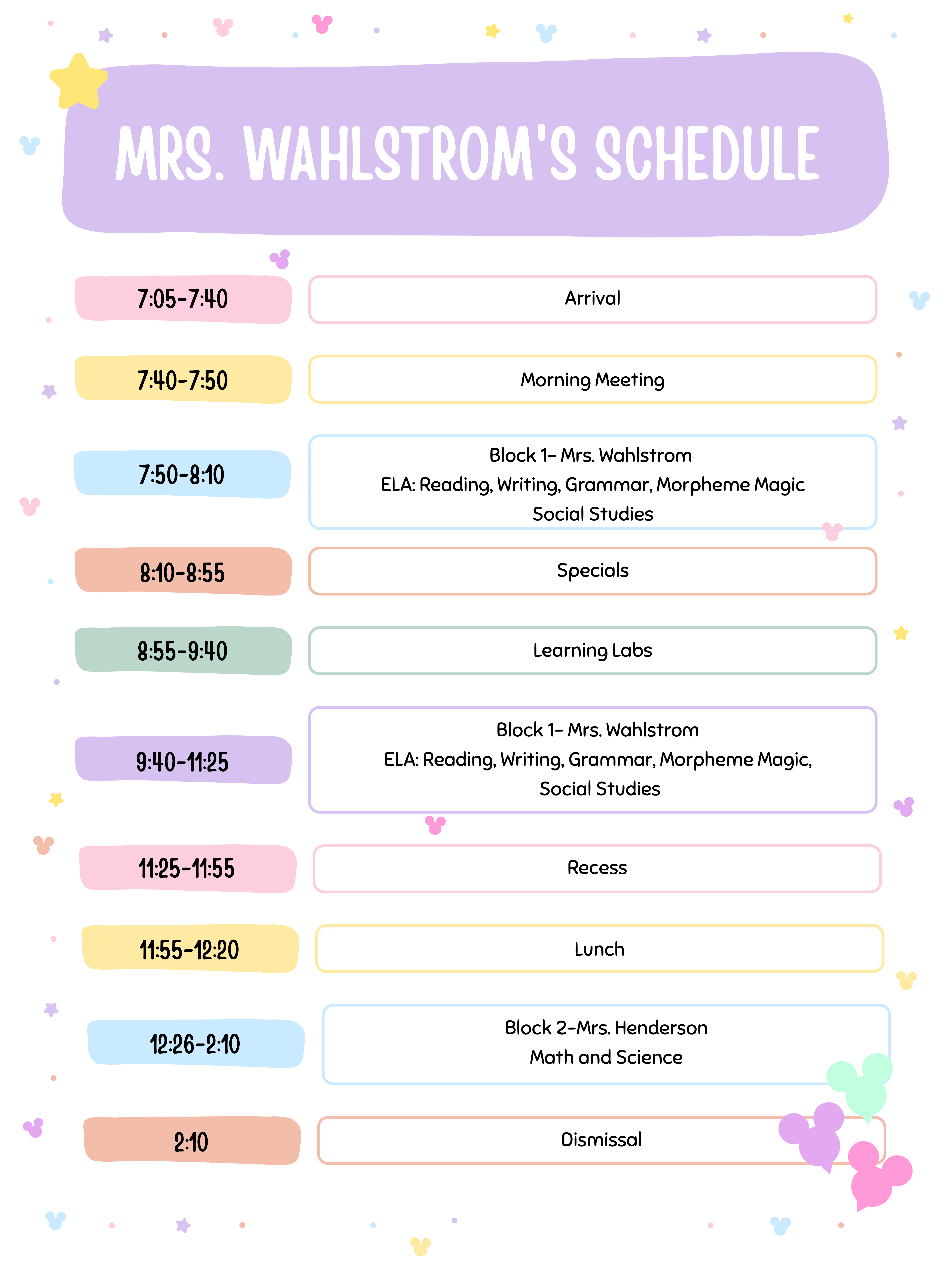
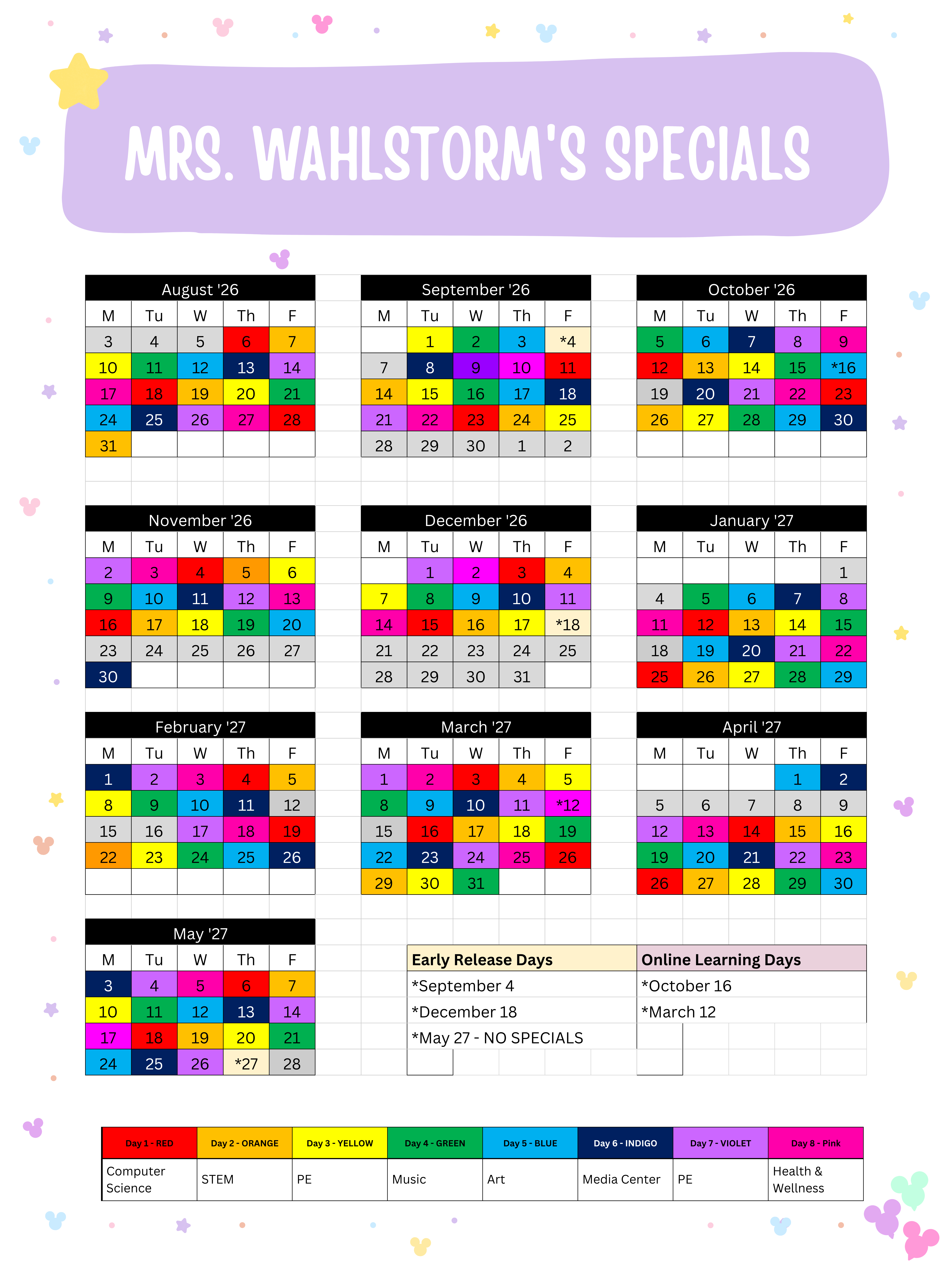
Specials meet 8:10 – 8:55 AM every day on an 8-day color rotation (Day 1 Red through Day 8 Pink). Find today's date below to see where your child goes — no need to squint at the year-long calendar. Grey days have no specials: there is no school November 23 – 27 for Thanksgiving Break. The rotation pauses rather than skipping a color, so Day 6 Indigo falls on Monday, November 30.
Your child starts the day in Mrs. Wahlstrom's room for ELA & Social Studies, then switches to Mrs. Henderson after lunch for Math & Science.
* Schedule is the same every day of the week. Students switch rooms between Block 1 and Block 2.
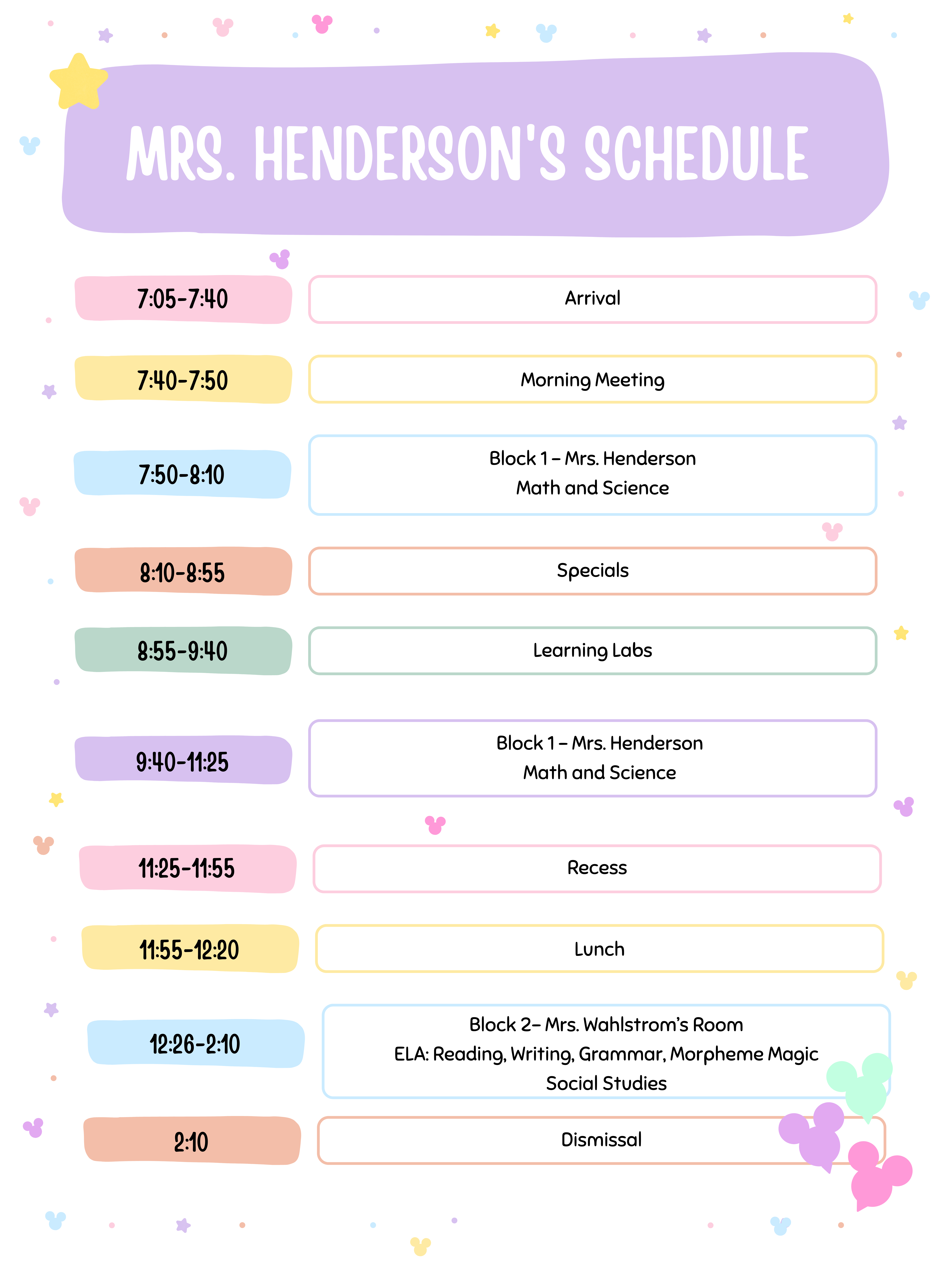
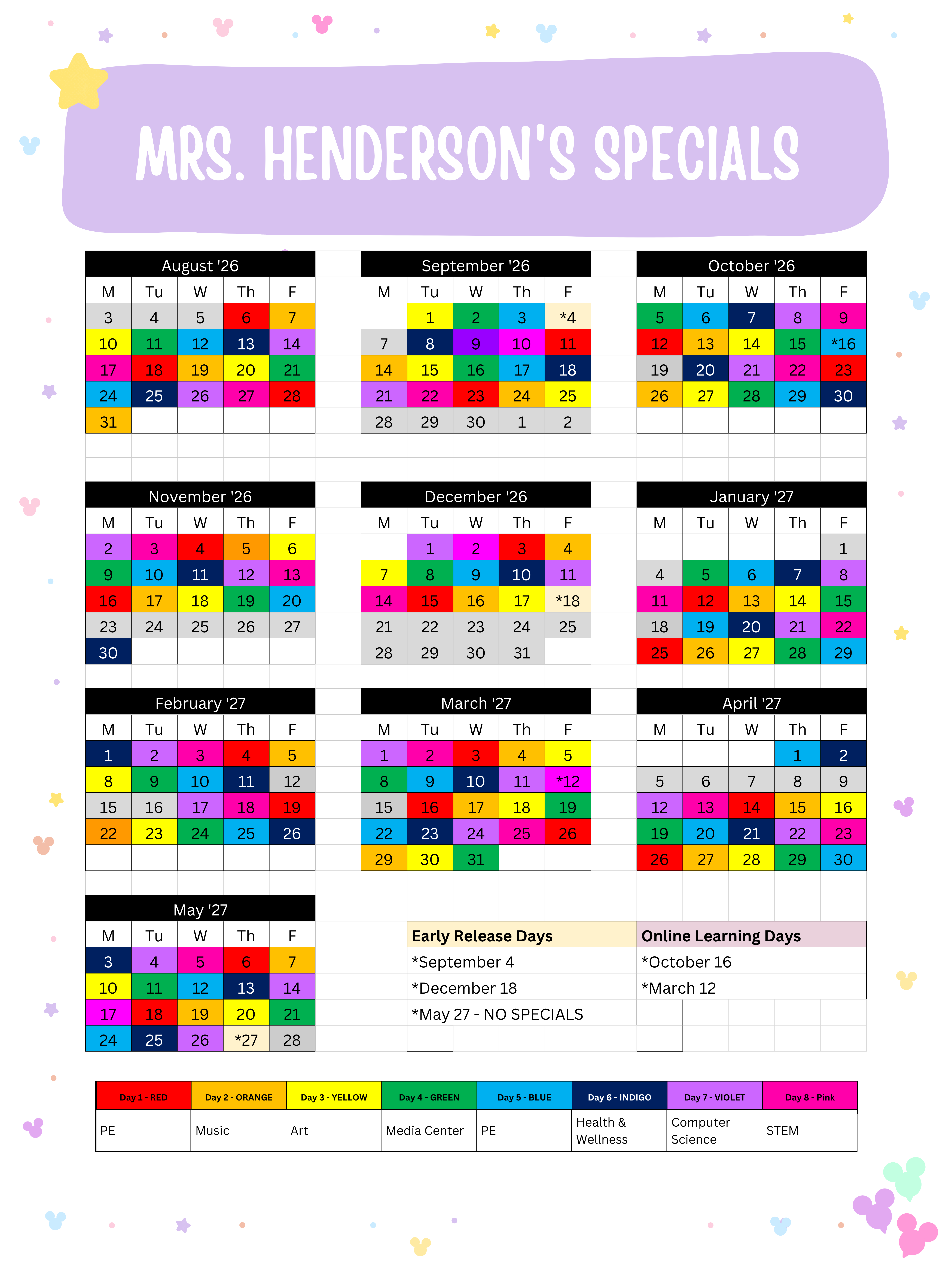
Specials meet 8:10 – 8:55 AM every day on an 8-day color rotation. The colors match Mrs. Wahlstrom's calendar, but each class visits a different special on each color day. Grey days have no specials: there is no school November 23 – 27 for Thanksgiving Break.
Your child starts the day in Mrs. Henderson's room for Math & Science, then switches to Mrs. Wahlstrom after lunch for ELA & Social Studies.
* Schedule is the same every day. Students assigned to Mrs. Henderson's class start with Math & Science, then switch to Mrs. Wahlstrom for ELA & Social Studies.
🎈 IMPORTANT DATES
Upcoming dates from November 16 · 2026–2027 · Rooms 803 & 804
📁 NEWSLETTER ARCHIVE
Every newsletter from our 2026–2027 school year